
What's Happening?
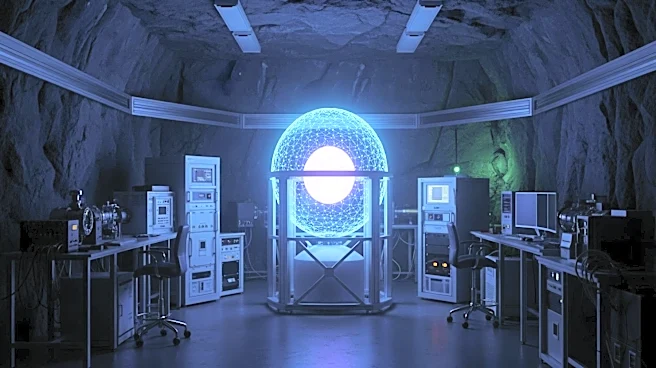
Researchers from the University of Warwick have introduced a unified method for detecting 'spacetime fluctuations,' which are tiny, random distortions in spacetime structure. These fluctuations, first
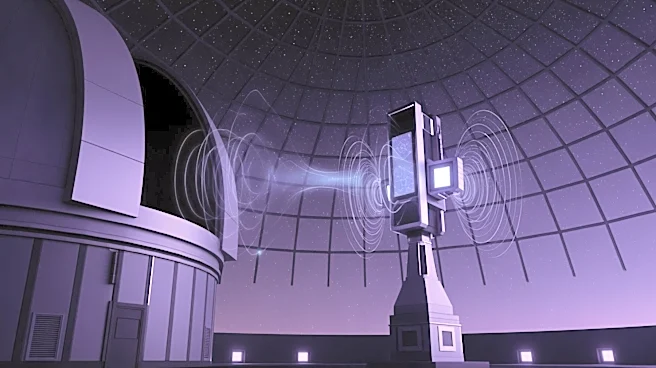
proposed by physicist John Wheeler, are a key element in various quantum gravity theories. The new approach categorizes these fluctuations into three main types, each with distinct measurable patterns. This framework allows existing laser interferometers, such as LIGO and smaller setups like QUEST and GQuEST, to detect these patterns. The research, published in Nature Communications, provides a practical guide for experimentalists to test quantum gravity predictions, potentially advancing our understanding of fundamental physics.
Why It's Important?
This development is significant as it bridges the gap between theoretical physics and experimental validation. By providing a clear framework for detecting spacetime fluctuations, the research enables scientists to test quantum gravity theories using current technology. This could lead to breakthroughs in understanding the universe's fundamental forces and the nature of spacetime. The ability to measure these fluctuations also opens new avenues for exploring other phenomena, such as dark matter and stochastic gravitational waves. The research underscores the importance of interdisciplinary collaboration in advancing scientific knowledge and could have far-reaching implications for physics and cosmology.
What's Next?
The next steps involve utilizing this framework to conduct experiments with existing interferometers. Researchers will aim to detect spacetime fluctuations and validate or refute various quantum gravity theories. This could lead to the development of more advanced interferometers tailored to these specific measurements. The findings may also inspire new theoretical models and experimental techniques, furthering our understanding of the universe. As the research progresses, it could influence future funding and policy decisions in the field of fundamental physics, highlighting the need for continued investment in scientific research and technology development.