




What's Happening?
South Korean police have initiated an investigation into a case of artificial intelligence-assisted cheating during the national qualification exam for tax accountants. The participant, who achieved the top rank in both rounds of the exam held in April
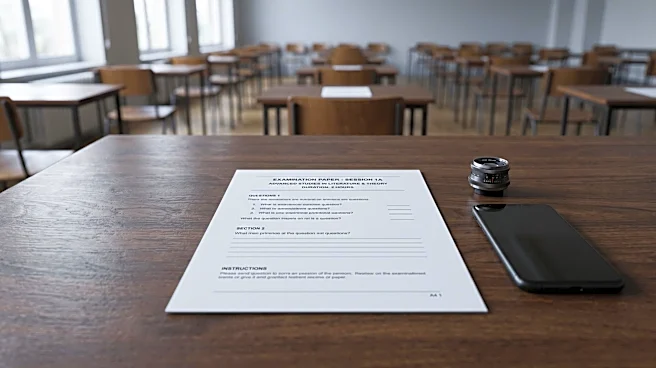
and July, confessed to using AI to obtain answers. The Seoul Metropolitan Police Agency received a written confession through the participant's lawyer, who also released a video where the candidate expressed deep regret. The cheating method involved photographing examination questions with a miniature camera, sending the images to an AI, and then receiving answers on a smartphone. The Human Resources Development Service of Korea (HRDK), which administers the exam, confirmed the incident and stated that two proctors were present. HRDK President Lee Byung-hun apologized for the incident and announced that the agency would file a criminal complaint against the participant for obstruction of work.
Why It's Important?
This incident highlights a significant challenge posed by advancing technology, particularly AI, to the integrity of high-stakes examinations. The use of AI for cheating undermines the fairness and credibility of national qualification exams, which are crucial for professional certification and public trust. The fact that the participant ranked first in both rounds suggests the potential effectiveness of such cheating methods, raising concerns about the validity of past and future exam results. The HRDK's decision to file a criminal complaint and the presidential administration's move to comprehensively inspect all suspected cases of AI-assisted cheating underscore the seriousness with which authorities are addressing this issue. This event could lead to a re-evaluation of current exam security protocols and the implementation of more sophisticated anti-cheating measures, potentially impacting how professional qualifications are assessed globally.
What's Next?
Following this confession, the South Korean presidential administration has decided to conduct comprehensive inspections of all suspected cases of AI-assisted cheating in national qualification exams. This indicates a systemic response to address the vulnerability of current examination systems to advanced technological cheating. The HRDK will proceed with a criminal complaint against the participant for obstruction of work, which could result in legal consequences for the individual. Furthermore, this incident is likely to prompt a review and overhaul of examination security measures, potentially including the adoption of AI-powered proctoring tools or more stringent physical checks to detect hidden cameras and smart devices. The lawyer's decision not to disclose additional details about the cheating method suggests an effort to prevent replication, but the broader implications for exam design and administration will need to be addressed to maintain public confidence in qualification processes.
Beyond the Headlines
This case extends beyond a simple cheating incident, touching upon ethical dilemmas and the societal impact of AI. The participant's admission of financial difficulties after leaving a job to start a business adds a layer of complexity, hinting at the pressures individuals face in competitive environments. The incident forces a re-evaluation of the balance between technological advancement and ethical conduct, particularly in educational and professional settings. It also raises questions about the 'arms race' between those developing cheating technologies and those designing countermeasures. The broader implication is a potential shift in how qualifications are perceived and validated, moving towards systems that are more resilient to technological exploitation. This could involve a greater emphasis on practical skills assessment, continuous evaluation, or adaptive testing methods that are harder to 'game' with AI.