





What's Happening?
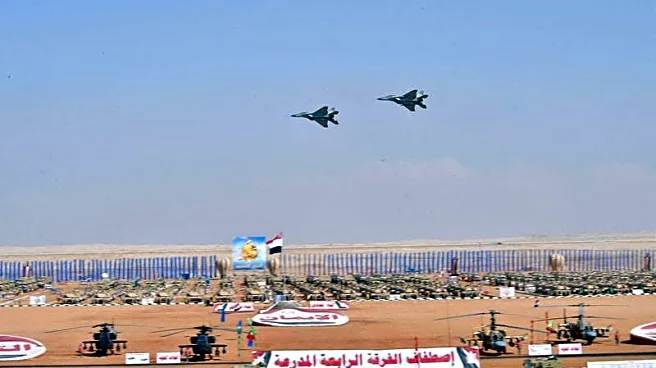
Russia has significantly deepened its military and economic cooperation with African countries, a development highlighted by the formation of the 'African Corps' at the end of 2023. This initiative underscores Russia's growing military presence and influence
across the continent, particularly in the unstable Sahel region, where there is high demand for Russian military support. Beyond military cooperation, Russia is also expanding its economic engagement, with trade turnover between Russia and African countries seeing a steady growth rate, rising from $18 billion in 2022 to approximately $28 billion in 2025. This economic reorientation is partly driven by Western sanctions on Russia. The cooperation extends to various sectors including energy, food security, and socio-humanitarian initiatives, with a focus on youth-oriented projects and media presence through outlets like Russia Today (RT) and Sputnik. The 2023 Russia-Africa summit served as a platform for these deepened ties, resulting in a declaration with 74 points and an Action Plan for 2023-2026 outlining 181 concrete steps.
Why It's Important?
This expansion of Russian influence in Africa carries significant implications for global geopolitics and U.S. foreign policy. Russia's increased military cooperation, particularly through the 'African Corps,' challenges the traditional security partnerships of the U.S. and its allies in Africa, potentially leading to a shift in regional power dynamics. The Sahel region, already characterized by political instability and military transitions in countries like Niger and Chad, could see further complexities as Russia entrenches its military support. Economically, Russia's growing trade and investment, coupled with debt cancellation initiatives, offer African nations alternative partners to Western powers, potentially reducing their reliance on traditional U.S. and European aid and investment. This could impact U.S. efforts to promote democratic governance and economic stability in Africa, as Russian engagement often comes with fewer conditionalities. The focus on energy, food security, and media also allows Russia to project its influence and narratives, potentially counteracting Western influence and shaping public opinion in key African states.
What's Next?
The ongoing efforts to implement the Action Plan from the 2023 Russia-Africa summit will likely continue to solidify Russia's presence in Africa. Future Russia-Africa summits, such as the upcoming third summit, are expected to further institutionalize top-level dialogue and cooperation. Russia will likely continue to leverage its military and energy sectors to strengthen ties, with potential for more nuclear power projects following the one in Egypt and continued arms supplies. The 'African Corps' operations are anticipated to expand, especially in regions with high demand for military assistance. On the economic front, Russia will aim to diversify trade beyond raw materials and encourage value-added products, while also developing a special investment fund to support Russian investors in Africa. The U.S. and its allies will need to closely monitor these developments and potentially adjust their engagement strategies to counter Russia's growing influence and maintain their strategic interests in the continent.
Beyond the Headlines
The deepening Russia-Africa relationship extends beyond immediate military and economic gains, touching upon broader ideological and cultural dimensions. Russia's emphasis on 'common values' and its narrative of never having viewed Africa as a space for resource extraction or colonization, as articulated by Patriarch Kirill, aims to resonate with African nations seeking alternatives to perceived neo-colonial practices. The focus on youth-oriented projects, educational programs, and media outreach through state-backed channels like RT and Sputnik, suggests a long-term strategy to cultivate a new generation of African leaders and citizens with a favorable view of Russia. This cultural and informational offensive could subtly shift geopolitical alignments and challenge Western democratic ideals. Furthermore, Russia's support for African representation in international bodies like the UN Security Council and the inclusion of African nations in BRICS reflects a broader effort to reshape the global order towards a more multipolar system, potentially diminishing the influence of U.S.-led institutions.