



What's Happening?
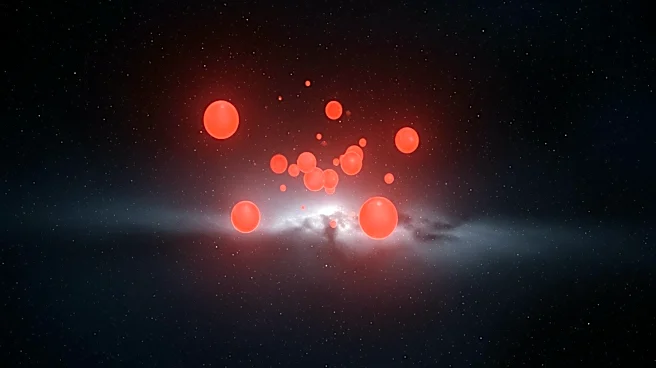
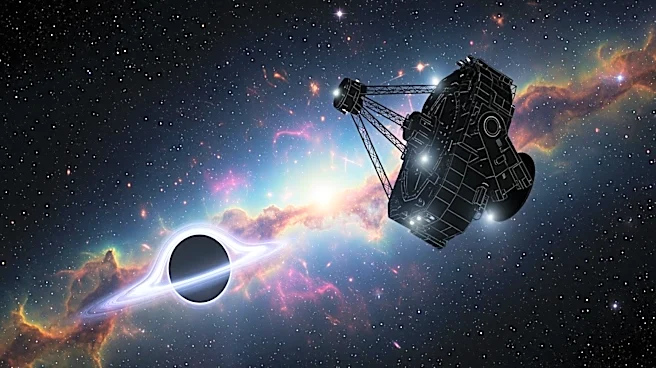
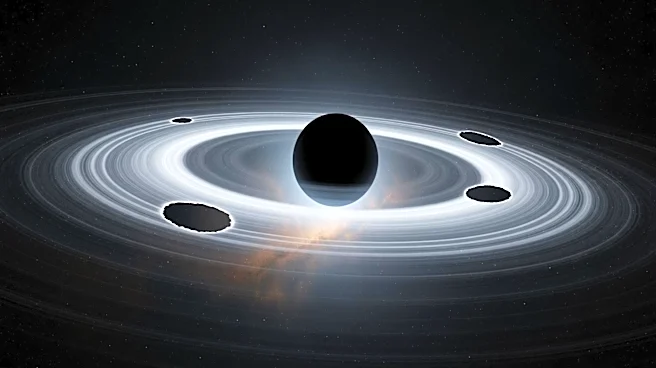
The James Webb Space Telescope has made a groundbreaking measurement of a supermassive black hole in the galaxy Abell2744-QSO1, which existed 700 million years after the Big Bang. This black hole, 50 million times the mass of the Sun, outweighs all the stars
in its host galaxy. The discovery challenges existing theories of black hole formation, suggesting that this black hole may have formed before its galaxy. The findings, published in Nature and Monthly Notices of the Royal Astronomical Society, highlight the unique characteristics of this early cosmic structure.
Why It's Important?
This discovery by the James Webb Space Telescope provides new insights into the formation and evolution of supermassive black holes. The fact that the black hole is more massive than its host galaxy's stars challenges the traditional understanding that galaxies form first, followed by black holes. This could lead to a reevaluation of cosmic evolution theories and enhance our understanding of the early universe. The research opens new avenues for studying primordial black holes and their role in galaxy formation.
What's Next?
Researchers will continue to study the implications of this discovery, exploring whether other early galaxies exhibit similar characteristics. The findings may prompt further investigations into the heavy seed and primordial black hole hypotheses. Future observations by the James Webb Space Telescope and other instruments will aim to identify more such objects, potentially reshaping our understanding of the universe's early history.