



What's Happening?
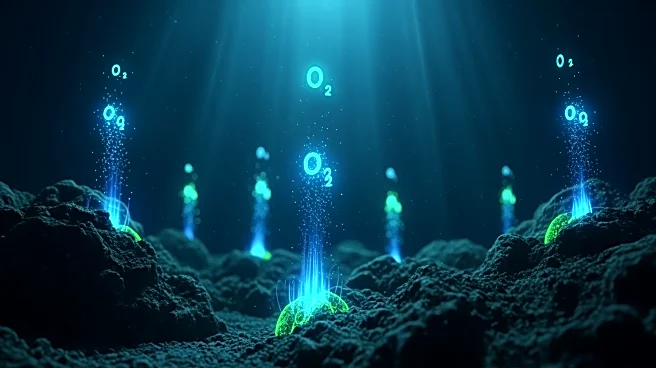
Researchers are delving into the unexpected discovery of 'dark oxygen' produced by metallic nodules on the seafloor in the Pacific Ocean's Clarion-Clipperton Zone. This phenomenon, first noted in 2024, challenges the traditional understanding that sunlight
is necessary for oxygen production. The nodules, which are rich in metals like cobalt, nickel, and manganese, appear to generate an electric current that breaks down seawater into hydrogen and oxygen. This discovery has sparked controversy, particularly with deep-sea mining companies that aim to harvest these nodules. The scientific team, led by Andrew Sweetman from the Scottish Association for Marine Science, is conducting further research to confirm the existence of this oxygen and understand its production process. They plan to use landers equipped with instruments to measure oxygen fluxes and analyze sediment cores and nodules for microbial activity.
Why It's Important?
The discovery of 'dark oxygen' could have significant implications for deep-sea ecosystems and the future of deep-sea mining. If these nodules indeed produce oxygen, they may support diverse marine life in the deep ocean, raising ethical and environmental concerns about mining activities. The findings challenge the mining industry's plans, as extracting these nodules could disrupt ecosystems that rely on this oxygen source. The research also highlights the need for more comprehensive studies before proceeding with deep-sea mining, which has been a contentious issue due to its potential environmental impact. The outcome of this research could influence international policies and regulations regarding deep-sea mining, affecting companies like The Metals Company, which has applied for mining permits.
What's Next?
The research team plans to continue their investigations by deploying landers to measure oxygen production and analyze microbial activity in the nodules. They aim to recreate deep-sea conditions in a high-pressure reactor to study the electrolysis process under extreme conditions. The findings will be crucial in addressing criticisms from mining companies and could lead to a reevaluation of deep-sea mining practices. The United Nations' International Seabed Authority has yet to decide on allowing mining in international waters, and the results of this research could play a pivotal role in shaping future decisions. The team is also preparing a rebuttal to a paper by The Metals Company, which questioned their initial findings.
Beyond the Headlines
The research into 'dark oxygen' not only challenges existing scientific paradigms but also raises broader questions about the ethical implications of exploiting deep-sea resources. The potential disruption of unique ecosystems and the unknown long-term effects of mining activities underscore the need for a cautious approach. This situation highlights the tension between economic interests and environmental conservation, a recurring theme in resource extraction industries. The study also emphasizes the importance of interdisciplinary research in understanding complex environmental phenomena and informing policy decisions.