
What's Happening?
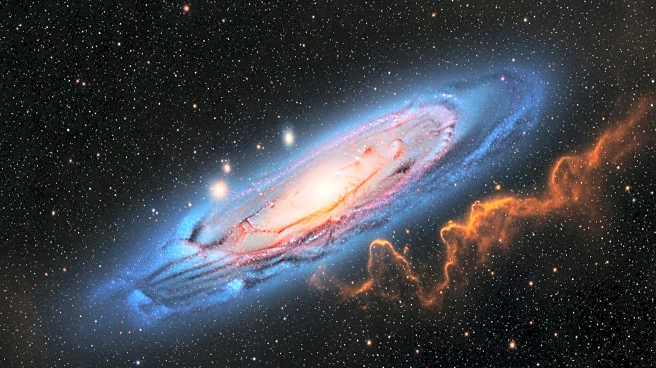
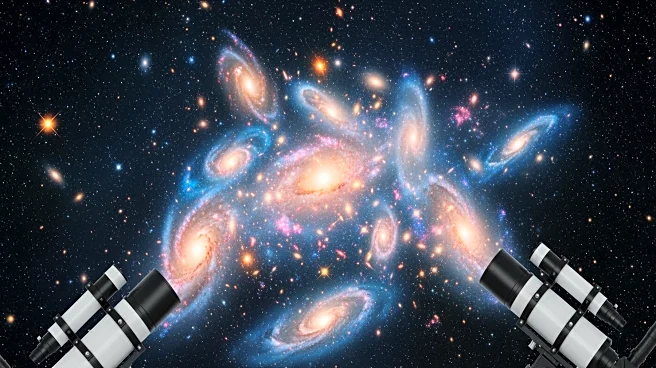
Astronomers have utilized the James Webb Space Telescope, Hubble Space Telescope, and the Atacama Large Millimeter/submillimeter Array to study young galaxies in the early universe. These observations have revealed that galaxies, existing just over a billion
years after the Big Bang, matured faster than previously expected. The study focused on 18 galaxies located approximately 12.5 billion light-years away, which were undergoing rapid star formation and exhibited higher levels of metals like carbon and oxygen. This discovery challenges previous models, as these galaxies were found to be more chemically mature than anticipated, suggesting a faster enrichment process than the expected billion-year timeline.
Why It's Important?
The findings have significant implications for our understanding of galaxy formation and evolution. The rapid maturation of these early galaxies suggests that the processes of star formation and metal enrichment occurred much faster than current models predict. This could lead to a reevaluation of the timelines and mechanisms involved in the early universe's development. The presence of rotating stellar disks in these galaxies, similar to those in the Milky Way, further indicates a level of structural evolution not previously accounted for in such young cosmic entities. These insights could reshape theories about the formation of the first stars and planets, impacting our broader understanding of cosmic history.
What's Next?
Researchers plan to use simulations of galactic growth and metal enrichment to further explore these findings. By combining observational data with theoretical models, scientists aim to gain a deeper understanding of the processes that led to the rapid maturation of these galaxies. This research could provide new insights into the formation of the first stars and planets, as well as the evolution of galaxies over time. The continued study of these early galaxies will likely influence future astronomical research and the development of new models to explain the universe's early stages.