






What's Happening?
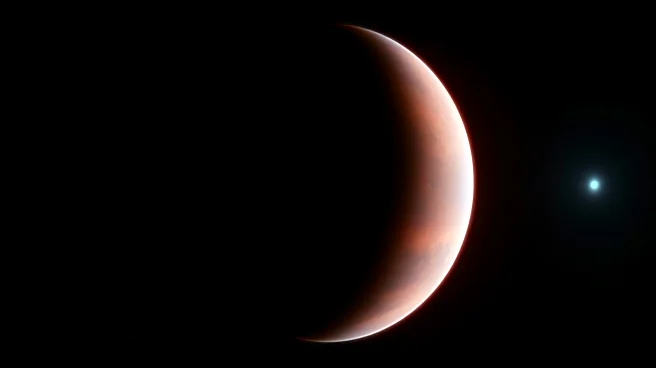
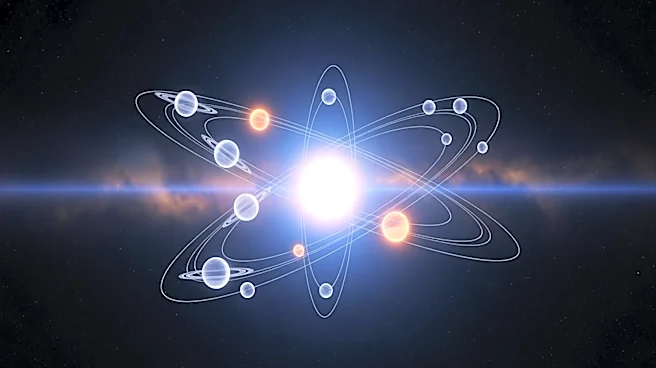
Astronomers have discovered an unusual planetary system around the red dwarf star LHS 1903, which defies conventional planet formation theories. The system features an unexpected arrangement of planets, with a rocky planet located farther from the star than
two gaseous planets. This 'inside-out' configuration challenges the traditional understanding that rocky planets form closer to stars while gas giants develop further away. The discovery was made using data from the European Space Agency's Cheops satellite and other telescopes. Researchers are exploring alternative explanations, such as sequential planet formation, to account for this anomaly.
Why It's Important?
The discovery of the LHS 1903 system prompts a reevaluation of existing planet formation models. It suggests that the processes governing planetary development may be more diverse than previously thought. This finding could lead to new insights into the formation and evolution of planetary systems, including our own Solar System. The research highlights the importance of continued exploration and observation to uncover the complexities of the universe. The implications extend to the broader field of astrophysics, potentially influencing future studies and theoretical frameworks.
Beyond the Headlines
The LHS 1903 system's unique configuration may indicate that planet formation is influenced by factors not yet fully understood. The concept of sequential planet formation, where planets develop one after another rather than simultaneously, could offer new perspectives on planetary evolution. This discovery also raises questions about the potential for diverse planetary environments and their capacity to support life. As astronomers continue to discover atypical systems, the need to adapt and expand theoretical models becomes increasingly apparent.