







What's Happening?
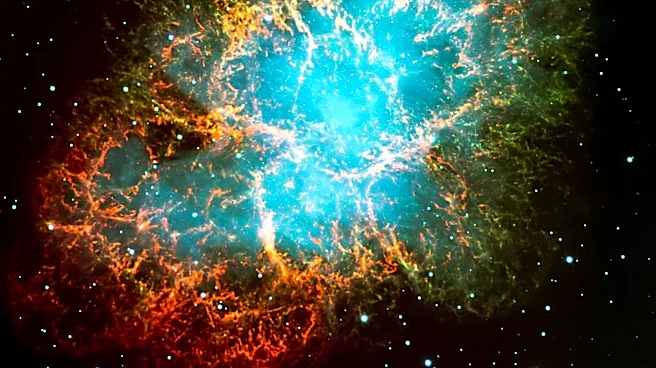
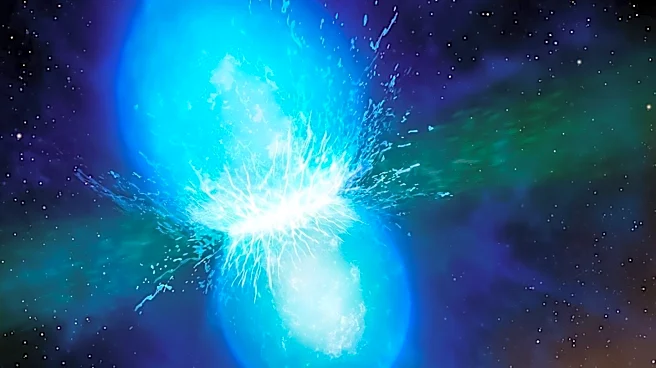
Scientists have discovered evidence of two massive stars in a binary system that both exploded as supernovas, creating the Jellyfish Nebula and another nebula, G189.6+3.3. This marks the first time such a pair has been identified, providing a rare opportunity
to study the complete evolutionary history of a massive binary system. The stars, located about 6,000 light-years from Earth in the constellation Gemini, were each tens of thousands of times more luminous than the sun before their explosions. The remnants left behind are believed to be neutron stars. This discovery, led by Miltiadis Michailidis from Stanford University, offers new insights into the life cycles of massive stars and the dynamics of binary systems.
Why It's Important?
The discovery is significant as it provides direct observational evidence of the evolution of massive stars in binary systems, a topic previously understood mainly through theoretical models. Understanding these systems is crucial for astrophysics, as it helps refine models of stellar evolution and the chemical enrichment of galaxies. The findings could also impact our understanding of supernova mechanisms and the formation of neutron stars, which are key to studying the universe's structure and evolution. This research could lead to advancements in predicting the behavior of other massive binary systems and their role in cosmic events.