
What's Happening?
Australia’s national science agency, CSIRO, has initiated an AU$8 million (approximately US$5.2 million) research program aimed at 'drought-proofing' dryland farming. The five-year program, named STRAP
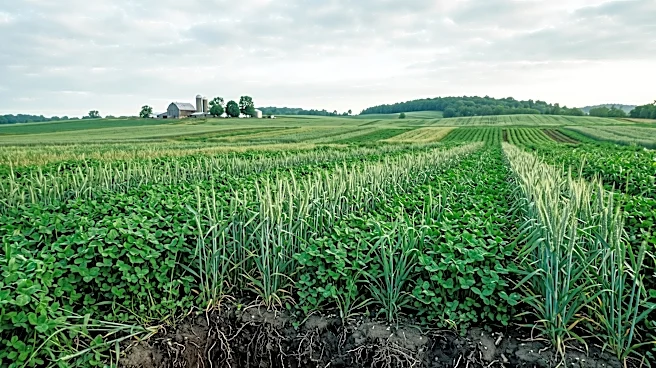
(Stress Testing Regenerative Agricultural Practices), will investigate whether regenerative farming practices, largely developed in Europe, can be successfully adapted to Australia's older, drier soils and more variable rainfall patterns. Trial plantings commenced this growing season across sites in South Australia, Victoria, and New South Wales. The project is funded by the Australian government’s Future Drought Fund and involves collaboration between CSIRO and ten partner organizations, including regional farming systems groups like the Ag Excellence Alliance and Mallee Sustainable Farming. Dr. Mark Farrell, CSIRO principal research scientist and project lead, emphasized that the program addresses the gap between existing regenerative agriculture research in wetter climates and the specific needs of Australian grain growers.
Why It's Important?
While this initiative is based in Australia, its implications are significant for U.S. agriculture, particularly in regions facing increasing drought and climate variability. The U.S. also has vast dryland farming areas, and the findings from STRAP could offer valuable insights into adapting regenerative practices to similar challenging environments. If successful, the research could provide a blueprint for U.S. farmers to enhance soil health, reduce reliance on synthetic inputs, and improve water retention, thereby increasing resilience against drought. This could lead to more sustainable agricultural practices, reduced environmental impact, and greater food security in the U.S. The project's focus on testing multiple practices simultaneously and integrating artificial intelligence and geospatial mapping tools for tracking greenhouse gas emissions and economic risk could also inform U.S. agricultural research and policy, potentially influencing federal funding for similar initiatives aimed at climate adaptation in farming.
What's Next?
The STRAP program is designed to run for five years, with initial results from the trial plantings expected in the coming seasons. Researchers will analyze data from both small, controlled plot trials and larger demonstration trials on commercial-scale paddocks. The integration of AI and geospatial mapping tools will be crucial for predicting how different practices perform across various regions and for assessing their economic viability and environmental impact. If the trials demonstrate positive outcomes, the adapted regenerative practices could be disseminated to Australian farmers, and potentially shared internationally, including with the U.S. agricultural sector. This could lead to policy recommendations for supporting regenerative agriculture, new agricultural technologies, and educational programs for farmers on climate-resilient farming techniques. The project's emphasis on economic proof for farmers before widespread adoption is a critical factor that will likely resonate with U.S. agricultural stakeholders.
Beyond the Headlines
The STRAP program highlights a global shift towards understanding and implementing climate-resilient agriculture. The core premise—that soil management advice needs to be tailored to local conditions rather than following a universal template—challenges conventional agricultural wisdom. This nuanced approach is vital for addressing the complex and varied impacts of climate change on food production worldwide. For the U.S., this implies a need for localized research and development in agricultural practices, moving beyond one-size-fits-all solutions. The project also touches upon the ethical dimension of sustainable food production, emphasizing the long-term health of the land and the economic well-being of farmers. The integration of advanced technologies like AI in agricultural research signifies a future where farming is increasingly data-driven and scientifically informed, aiming to balance productivity with ecological stewardship. This could lead to a redefinition of 'best practices' in agriculture, with significant implications for global food systems and environmental policy.