



What's Happening?
A 25-year-long experiment in the Amazon Rainforest, known as the Esecaflor Project, has provided critical insights into how the biome responds to prolonged water stress. Conducted in Pará, Brazil, the study artificially subjected a one-hectare plot of
rainforest to half its normal rainfall for two decades. Researchers observed significant changes, including the loss of large trees (those with trunk diameters over 50 centimeters) which are more vulnerable to water shortages. After eight years, the plot had lost 40% of its total biomass, peaking at nearly 50% by the 15th year. However, the forest demonstrated a surprising adaptability; smaller trees redistributed the limited water, leading to a new eco-hydrological stability and a reversal in mortality trends. Scientists involved in the project, such as British ecologist Patrick Meir and tropical ecosystem specialist Lucy Rowland, emphasize that the forest did not transform into a savanna but rather into a novel, highly degraded ecosystem. The experimental drought concluded in November 2024, and researchers are now studying the forest's recovery.
Why It's Important?
This long-term study is crucial for understanding the Amazon's future in a warming world with increasing drought frequency. The findings challenge previous assumptions that the rainforest might convert to a savanna, instead suggesting a transformation into a degraded, yet still tropical, ecosystem. This distinction is vital for conservation strategies and climate modeling, as it implies a different set of ecological challenges and potential interventions. The resilience shown by smaller trees offers a glimmer of hope regarding the forest's capacity to adapt, but the significant loss of large trees has profound implications for carbon storage and the hydrological cycle. Large trees are essential for removing carbon from the atmosphere and recycling rainwater, which contributes to the formation of 'flying rivers' that influence regional climate. The degradation observed, even with adaptation, indicates a reduced capacity for the forest to perform its critical ecological functions, impacting global climate regulation and biodiversity.
What's Next?
With the artificial drought concluded in November 2024, the Esecaflor Project has entered a new phase focused on observing the forest's recovery. Researchers are now investigating whether large tree species, such as kapok, andiroba, and angelim vermelho, can regrow in this altered environment. This recovery process is expected to be slow, potentially taking decades or even centuries, during which the forest will likely face more frequent natural droughts. Understanding the differences in recovery rates between various tree sizes and species is a current priority for the project. The long-term monitoring will assess if the forest can regain its original biomass and stature, or if it will remain a more open, lower-biomass ecosystem, potentially making it more vulnerable to future climate extremes. The ongoing research aims to provide further data to inform conservation efforts and climate change mitigation strategies for the Amazon.
Beyond the Headlines
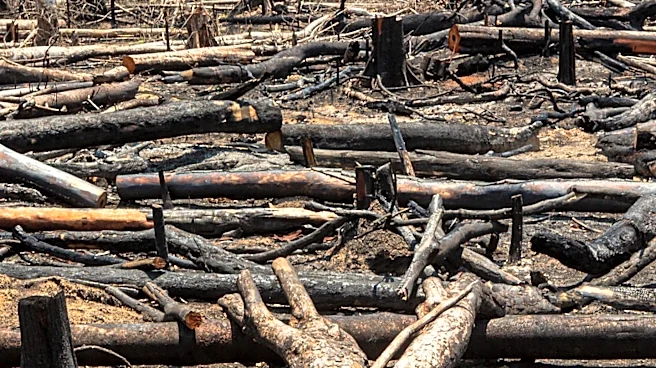
The Esecaflor Project's findings extend beyond immediate ecological observations, highlighting deeper implications for how humanity perceives and manages natural ecosystems. The study underscores the critical difference between controlled scientific experiments and the widespread destruction caused by human activities like deforestation and fires. As project coordinator Antonio Lôla da Costa notes, while the experimental drought led to adaptation, human-induced destruction on a large scale prevents recovery. This emphasizes the ethical responsibility of human actions in shaping the future of vital biomes. The research also subtly critiques the negative connotation often associated with 'savanna,' reminding us that such ecosystems, like Brazil's Cerrado, are valuable and species-rich in their own right, not merely degraded wastelands. This calls for a more nuanced understanding of ecological transitions and the importance of preserving all types of natural environments, rather than solely focusing on preventing one specific type of transformation.