

What's Happening?
Researchers at Columbia University, Luca Comisso and Felipe A. Asenjo, have identified a process called 'gravitational reconnection' by reinterpreting Einstein's equations. This discovery suggests that gravitational field structures can break and reconnect,
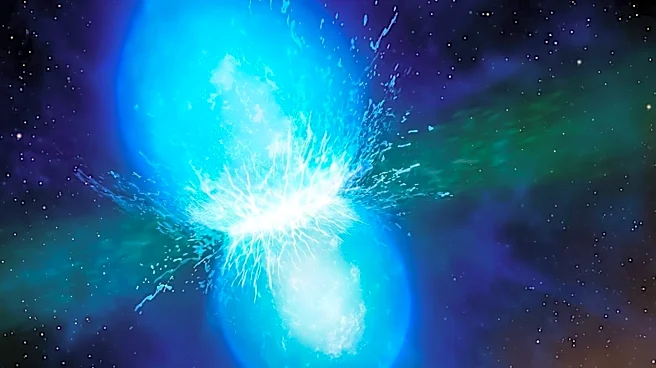
similar to magnetic reconnection in plasmas, which powers phenomena like solar flares. When gravitational reconnection occurs, energy is transferred from the gravitational field into matter. This new perspective on gravity could help physicists better understand extreme cosmic events, such as the merger of two neutron stars into a black hole, where gravitational forces are immense and space-time is highly distorted. The findings, published in Physical Review D, build upon earlier research that revealed previously unrecognized rules constraining space-time evolution.
Why It's Important?
This theoretical discovery is significant because it offers a novel framework for understanding fundamental processes in the universe that are currently difficult to model with conventional supercomputer simulations. By drawing an analogy between gravitational fields and plasmas, the researchers have opened a new avenue for applying plasma physics methods to gravitational phenomena. This interdisciplinary approach could lead to more accurate predictions of energy release during cosmic events and the gravitational-wave signatures they produce, which are detected by observatories like LIGO. The ability to identify fundamental rules governing gravitational field behavior, rather than solely relying on complex simulations, could accelerate advancements in astrophysics and our comprehension of the most energetic events in the cosmos.
What's Next?
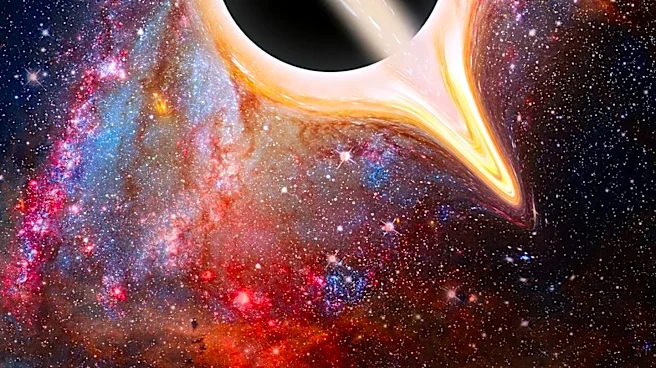
The immediate next step for researchers is to investigate how gravitational reconnection might manifest in specific astrophysical settings, such as merging black holes, and to determine if it produces measurable effects. This will involve further theoretical work and potentially new computational models to explore the implications of this process. The goal is to predict the amount of energy released during such events and the unique signatures they might leave in gravitational waves, which could then be sought by gravitational-wave observatories. The research, supported by the National Science Foundation and NASA, will continue to explore the deeper implications of this new interpretation of Einstein's equations.
Beyond the Headlines
The concept of gravitational reconnection challenges and expands our understanding of gravity, a fundamental force of nature. It highlights how reinterpreting established scientific theories can lead to profound new insights, even a century after their initial formulation. This discovery underscores the power of interdisciplinary research, where methods from one field (plasma physics) can unlock secrets in another (astrophysics). Philosophically, it suggests that the universe's most extreme phenomena might operate under elegant, unifying principles that are only now being uncovered. The ongoing quest to understand gravity at its most extreme also pushes the boundaries of computational physics, as researchers strive to simulate and predict events that defy intuitive understanding.