
What's Happening?
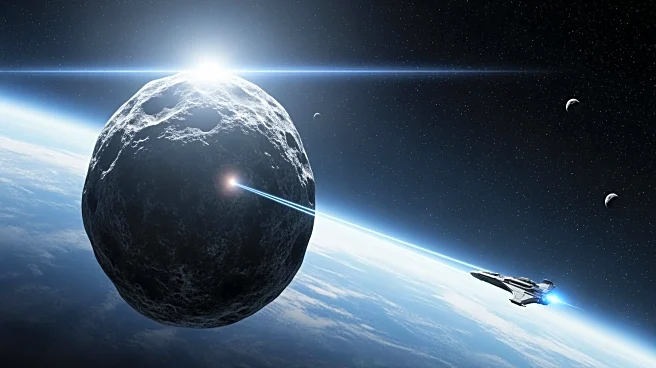
An international team of researchers has revisited the concept of using nuclear warheads to deflect asteroids that pose a threat to Earth. This idea is explored in a new paper published in Nature Communications,
where scientists from CERN and the University of Oxford conducted experiments to understand how asteroid materials react to physical stress. Using CERN's Super Proton Synchrotron, they simulated nuclear deflection scenarios and found that metal-rich asteroids are more resilient than previously thought. The study suggests that larger nuclear devices could be used without shattering the asteroid, providing a potential emergency option for planetary defense.
Why It's Important?
The research highlights the importance of developing effective planetary defense strategies to protect Earth from potential asteroid impacts. The findings could influence future policies and international collaborations aimed at mitigating asteroid threats. By demonstrating the feasibility of nuclear deflection, the study provides a viable option for scenarios where non-nuclear methods may be insufficient. This research is crucial for ensuring global safety and preparedness against cosmic threats, potentially saving lives and preventing catastrophic damage.
What's Next?
The researchers plan to study more complex asteroid materials to refine their understanding of nuclear deflection. Upcoming missions by NASA and the European Space Agency to study the asteroid Apophis will provide additional data to enhance these strategies. The scientific community and policymakers will likely engage in discussions to evaluate the ethical and practical implications of using nuclear technology for planetary defense. Continued research and international cooperation will be essential to develop comprehensive defense mechanisms against asteroid threats.