
What's Happening?
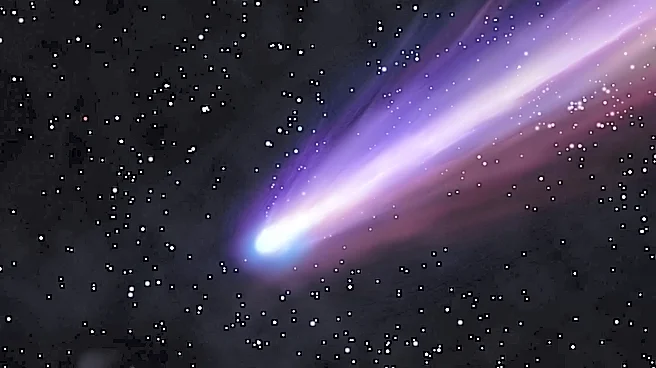
NASA's Jet Propulsion Laboratory has identified a near-Earth object, previously thought to be an asteroid, as a comet. The object, known as 1998 SH2, exhibited irregular motion, prompting further investigation.
Using optical astrometry and powerful observatories, scientists confirmed the presence of a weak tail, indicating cometary activity. This discovery was made possible during the object's close approach to Earth in August 2025. The study, published in Nature Astronomy, highlights the importance of tracking near-Earth objects to distinguish between asteroids and comets, which can have different orbital behaviors due to outgassing.
Why It's Important?
The identification of 1998 SH2 as a comet has significant implications for planetary defense. Comets, unlike asteroids, can exhibit nongravitational perturbations due to outgassing, affecting their trajectories. Understanding these perturbations is crucial for assessing potential Earth impact risks. The research also sheds light on 'dark comets,' which lack visible cometary features but exhibit similar perturbations. This discovery emphasizes the need for continuous monitoring of near-Earth objects to improve impact risk assessments and planetary defense strategies.
What's Next?
NASA's upcoming Near-Earth Object (NEO) Surveyor mission will enhance the detection of hard-to-find objects like dark comets and asteroids. This next-generation space survey telescope will support efforts to track and analyze near-Earth objects, providing critical data for planetary defense. The mission aims to improve the understanding of these objects' orbits and potential impact risks, contributing to global efforts to safeguard Earth from potential collisions.