
What's Happening?
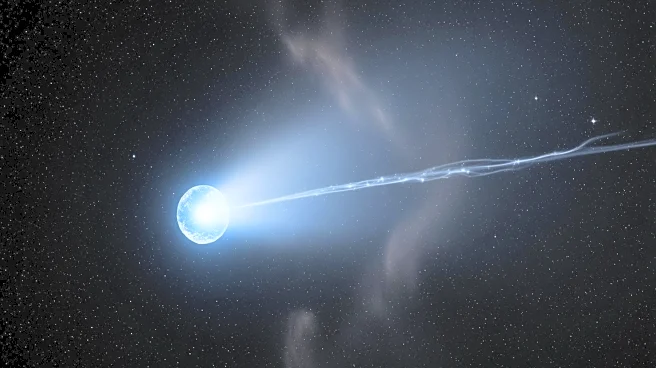
The Hubble Space Telescope has captured a new image of the interstellar comet 3I/ATLAS, confirming its active state even after its close approach to the Sun. Taken on November 30, 2025, the image shows
the comet's bright nucleus surrounded by a coma of gas and dust, with background stars appearing as streaks due to the comet's rapid motion. This observation is significant as 3I/ATLAS is only the third interstellar object observed in our solar system. The data from Hubble, along with observations from NASA's Psyche mission and ESA's JUICE spacecraft, are helping scientists refine their understanding of the comet's trajectory and behavior. The comet is currently moving away from the Sun and will be closest to Earth around December 19, 2025.
Why It's Important?
The observation of 3I/ATLAS provides valuable insights into the nature of interstellar objects, which are rare visitors to our solar system. Understanding the composition and behavior of such comets can offer clues about the conditions and processes in other star systems. The data collected by Hubble and other missions contribute to the broader scientific knowledge of cometary physics and the dynamics of interstellar objects. This research could have implications for future space exploration and the study of the solar system's formation and evolution. Additionally, the findings may influence the development of strategies for tracking and studying similar objects in the future.
What's Next?
As 3I/ATLAS continues its journey through the solar system, astronomers will have opportunities to observe it using telescopes. The best viewing times for those with telescopes are in mid to late December, particularly before sunrise. These observations will allow scientists to gather more data on the comet's activity and refine their models of its path. The James Webb Space Telescope is also set to observe the comet, focusing on detecting specific ices and organics. The continued study of 3I/ATLAS will enhance our understanding of interstellar objects and their interactions with the solar environment.