


What's Happening?
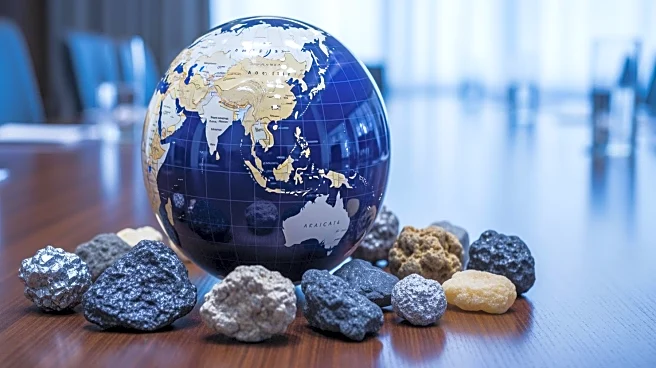
Finance ministers from the G7 and other major economies convened in Washington to address the global reliance on Chinese rare earth elements. The meeting, led by US Treasury Secretary Scott Bessent, included representatives from Japan, Britain, France,
Germany, Italy, Canada, the US, and officials from Australia, Mexico, South Korea, and India. The discussions focused on establishing a price floor and forming new partnerships to diversify and secure alternative supplies of critical minerals. This initiative comes in response to China's recent export controls on rare earths, particularly affecting Japan. Japanese Finance Minister Satsuki Katayama emphasized the need for swift action to reduce reliance on China, proposing policy measures that include public financial support, tax incentives, and trade measures. The meeting highlighted the importance of these minerals for defense technologies, semiconductors, and renewable energy components.
Why It's Important?
The reliance on Chinese rare earths poses significant risks to global supply chains, especially for industries critical to national security and technological advancement. China's dominance in refining these minerals, which are essential for various high-tech applications, gives it substantial leverage over global markets. The G7's efforts to diversify supply sources aim to mitigate these risks and ensure stable access to these materials. This move could lead to increased investment in alternative sources and technologies, potentially reshaping the global market for critical minerals. Countries that successfully reduce their dependence on Chinese supplies may gain a strategic advantage in securing their industrial and technological sectors.
What's Next?
The discussions in Washington are expected to lead to concrete actions, including the establishment of a rare-earths price floor and the development of partnerships to boost non-Chinese supplies. The French presidency of the G7 will likely prioritize this issue, with further talks anticipated to address unresolved challenges. European countries, in particular, are urged to accelerate their efforts in developing domestic supplies and recycling capabilities. The EU's focus on financing and raw materials development will be crucial in reducing dependencies and broadening supply chains. The outcome of these initiatives could significantly impact global trade dynamics and the geopolitical landscape.