

What's Happening?
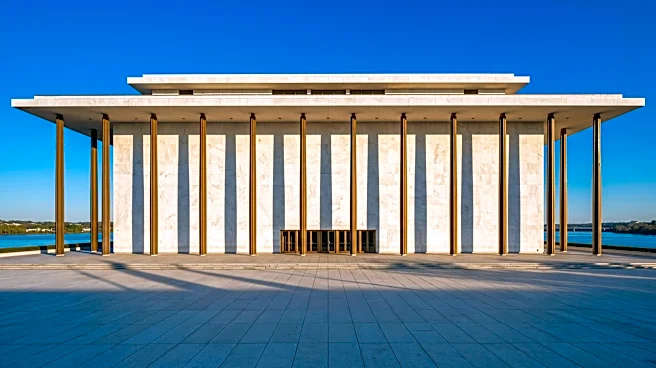
The Trump administration has threatened to demolish the John F. Kennedy Center for the Performing Arts if a proposed $250 million renovation is not carried out. This warning was issued in a court filing by Justice Department attorney Brantley T. Mayers,
who stated that without these efforts, the Center would 'deteriorate further into an unsafe, decrepit structure that will be required to be taken down.' The administration's lawyers suggested that an outdoor amphitheater, simpler and more economical to build and maintain, could replace the current structure. This development is part of a prolonged dispute over President Trump's attempts to associate his name with the Kennedy Center. A federal judge previously ruled that only Congress could change the Center's name, which is a memorial to President John F. Kennedy. Despite this, the Center's board, largely composed of Trump appointees, voted to change the building's signage to include 'Restored and Renovated by President Donald J Trump' and to name the grounds the 'President Donald J Trump Plaza.' The administration argues this does not violate the injunction as the formal name remains unchanged.
Why It's Important?
This situation is important as it highlights a significant conflict between the executive branch and judicial rulings regarding a national cultural institution. The threat of demolition for a landmark like the Kennedy Center, established by Congress as a living memorial, underscores the administration's aggressive stance in its efforts to leave a physical mark on the nation's capital. This move could set a precedent for how future administrations interact with and potentially alter national monuments and cultural sites. The dispute also raises questions about the independence of the Kennedy Center's board, now predominantly composed of Trump appointees, and its role in upholding the institution's original purpose. Furthermore, the potential demolition of a major performing arts venue could have a profound impact on the arts community, artists, and cultural programming in Washington D.C., potentially leading to a loss of performance spaces and a disruption of established cultural events.
What's Next?
A federal judge is scheduled to hear a fresh legal challenge to President Trump's efforts to put his name on the Kennedy Center. This hearing will address a request by Democratic Congresswoman Joyce Beatty to stop the proposed signage changes and the two-year closure for renovations. The administration's court filing is a response to Beatty's motion. Depending on the judge's ruling, the Kennedy Center could either proceed with the renovations and signage changes as proposed by the board, or the administration's plans could be blocked, potentially leading to further legal battles. Major stakeholders, including political leaders, historic preservation groups, and the arts community, are expected to react strongly to the court's decision, with potential protests and further legal challenges if the demolition threat is not averted. The future of the Kennedy Center, both its physical structure and its identity as a memorial, hangs in the balance.
Beyond the Headlines
Beyond the immediate legal and political ramifications, this dispute touches upon deeper ethical and cultural dimensions concerning the preservation of national heritage and the politicization of cultural institutions. The attempt to rename or significantly alter a memorial dedicated to a former president, especially one established by Congress, raises questions about respect for historical legacy and the potential for political figures to appropriate public symbols for personal branding. The administration's argument that the Center is 'structurally unsound, fundamentally unsafe, and embarrassing to the Nation’s Capital' could be seen as a tactic to justify its actions, potentially undermining public trust in the stewardship of national assets. This situation could trigger a broader debate about the governance of cultural institutions and the checks and balances required to protect them from political interference, potentially leading to calls for legislative action to safeguard such memorials in the future.