







What's Happening?
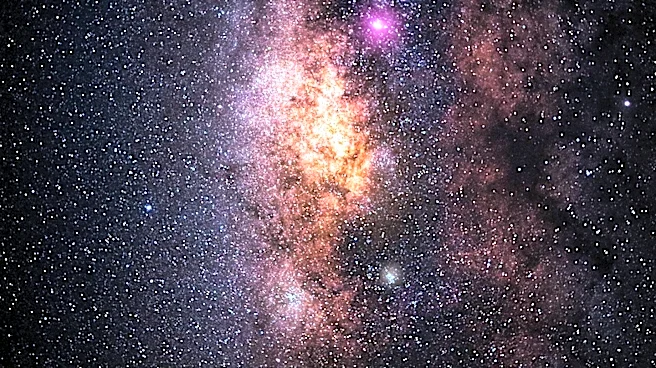
A radio structure, previously thought to be a massive feature towering over the Milky Way's center, has been reclassified as a nearby stellar bubble. Initially discovered in 1984, the structure was believed to be a result of an eruption from the galaxy's
central black hole, Sagittarius A*. However, new observations have placed the so-called Galactic Center Lobe much closer to Earth, approximately 6,500 light-years away, and identified it as a closed shell of ionized hydrogen. This finding aligns with independent studies from 2024, which also suggested the object was in the foreground. The reclassification was achieved through optical integral-field spectroscopy, revealing the structure as a coherent bubble rather than a remnant of a galactic nucleus outflow.
Why It's Important?
This discovery is significant as it challenges long-held assumptions about the structure's origin and nature, providing a clearer understanding of the Milky Way's composition. By identifying the structure as a stellar bubble rather than a black hole eruption remnant, astronomers can better map the galaxy's features and dynamics. This reclassification also highlights the complexities of observing our galaxy from within, where overlapping structures can lead to misinterpretations. The findings underscore the importance of continuous observation and technological advancements in astronomy, which can lead to more accurate cosmic mapping and understanding of galactic phenomena.
What's Next?
Future research will focus on identifying the stellar population responsible for the ionization of the bubble, as the current explanation remains incomplete. The study of this structure may also lead to further insights into the lifecycle of massive stars and their impact on surrounding interstellar environments. Additionally, astronomers will continue to refine their methods for observing and interpreting cosmic structures, potentially leading to more discoveries about the Milky Way and other galaxies.
Beyond the Headlines
The reclassification of the Galactic Center Lobe illustrates the challenges of astronomical observations from within the Milky Way. It emphasizes the need for careful analysis and the potential for misinterpretation when structures overlap along the line of sight. This case serves as a reminder of the dynamic and evolving nature of scientific understanding, where new data can significantly alter previous conclusions.