



What's Happening?
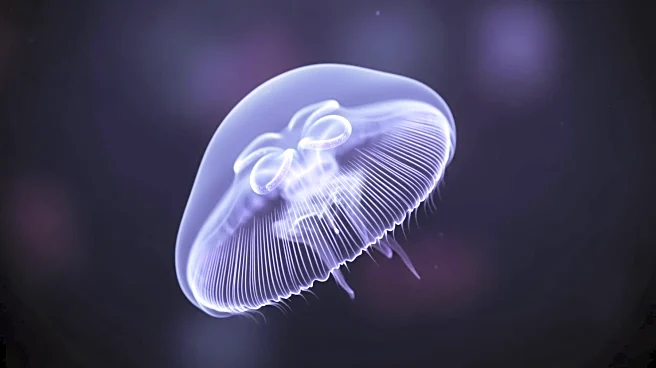
Recent research has resolved a long-standing debate in evolutionary biology by identifying comb jellies as the first animals to branch off from the common ancestor of all animals. This discovery was made through a novel technique that examines the arrangement
of genes on chromosomes, rather than just the gene sequences. The study found that comb jellies, unlike sea sponges, have retained a gene arrangement similar to that of single-celled non-animal organisms, suggesting they diverged earlier. This positions comb jellies as the most genetically isolated animals, providing a new foundation for studying the evolution of complex life forms.
Why It's Important?
This finding has significant implications for understanding the evolution of complex life. By establishing comb jellies as the earliest branch, scientists can now study evolutionary developments with a clearer understanding of their origins. This could lead to new insights into how complex features like nervous systems and digestive tracts evolved. The research also highlights the importance of genome structure analysis in resolving biological questions, potentially influencing future studies across various branches of life.