

What's Happening?
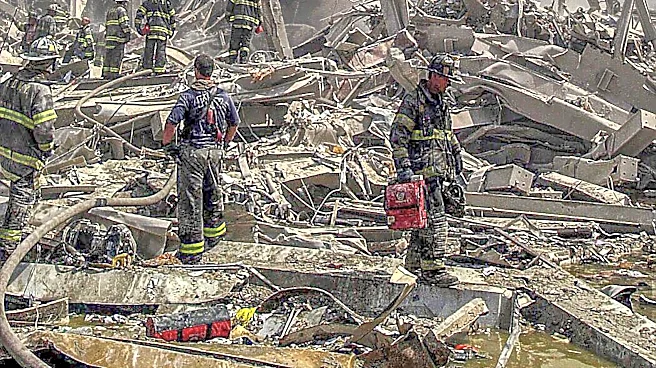
President Trump has launched an attack on American media outlets, specifically New York Magazine, over reports questioning his actions and presence at Ground Zero following the September 11, 2001, attacks. The controversy arises as the 25th anniversary
of the 9/11 attacks approaches, which targeted New York City and Washington D.C., resulting in approximately 3,000 deaths. President Trump asserts that he was present at Ground Zero shortly after the collapse of the towers with a large group of construction workers from his company, contrary to media narratives suggesting his absence. He claims to have discussed this during a speech at the 'Tunnel to Towers' event in Washington D.C. and provided video evidence to support his account, including testimony from Matthew Calamari, then head of security. President Trump also criticized New York Magazine writer Haberman, accusing her of fabricating stories and spreading misinformation about his involvement.
Why It's Important?
This dispute highlights the ongoing tension between President Trump and certain media organizations, particularly concerning historical narratives and public perception. The 9/11 attacks remain a deeply sensitive and significant event in American history, and any questioning of a public figure's actions during that time can evoke strong reactions. President Trump's defense of his record and his accusations of 'fake media' contribute to a broader political discourse where trust in traditional news outlets is frequently challenged. This situation underscores the importance of factual accuracy in reporting, especially when dealing with events of national tragedy, and the potential for such narratives to be weaponized in political contexts. The public's understanding of historical events can be shaped by these ongoing debates, influencing collective memory and future political discussions.
What's Next?
The ongoing debate surrounding President Trump's actions during 9/11 is likely to continue, especially as the 25th anniversary of the attacks draws more attention. Media outlets may further investigate or reiterate their original reports, potentially leading to more exchanges between President Trump and the press. This could also prompt other individuals who were present at Ground Zero to come forward with their recollections, either supporting or refuting the various claims. The broader implications could include a renewed focus on the role of media in shaping historical narratives and the challenges of verifying information in a highly polarized environment. Political figures and commentators may also weigh in, further politicizing the historical event and its interpretations.
Beyond the Headlines
The controversy extends beyond a simple factual dispute, touching upon deeper issues of historical revisionism, media credibility, and the weaponization of memory in political discourse. President Trump's consistent narrative of being unfairly targeted by 'fake media' is a recurring theme in his public statements, and this particular instance serves as another example of how historical events can be reinterpreted to fit political agendas. The emotional weight of 9/11 makes any discussion surrounding it particularly potent, and attempts to control or challenge the narrative can have significant cultural and social repercussions. This situation also raises questions about the responsibility of public figures to accurately represent their past actions and the media's role in holding them accountable, especially when those actions are tied to moments of national crisis.