


What's Happening?
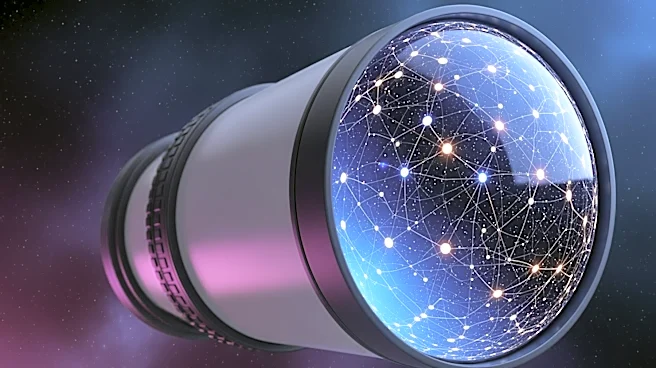
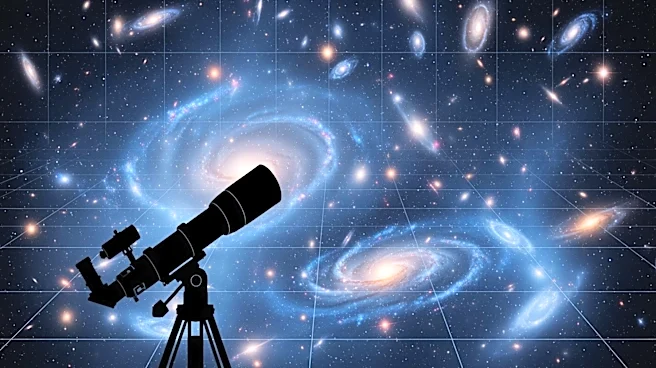
The Dark Energy Spectroscopic Instrument (DESI) has successfully created the largest high-resolution 3D map of the universe, showcasing a web-like structure formed by millions of galaxies. This map, developed over a five-year survey, has detected over 47
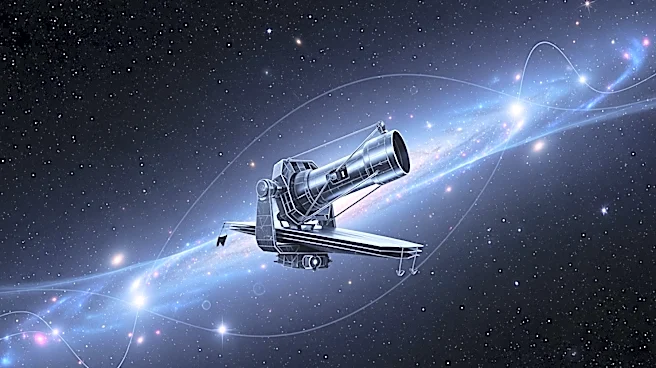
million galaxies and more than 20 million nearby stars in the Milky Way. DESI, mounted on the Nicholas U. Mayall 4-meter Telescope at Kitt Peak National Observatory in Arizona, uses 5,000 robotic fiber-optic sensors to capture light from distant celestial objects. The map allows scientists to track how dark energy has influenced the universe's structure over the past 11 billion years. The project is a massive international collaboration involving more than 900 researchers from over 70 institutions, led by Lawrence Berkeley National Laboratory and funded by the U.S. Department of Energy Office of Science.
Why It's Important?
This development is significant as it provides a comprehensive view of the universe's structure and offers insights into the mysterious dark energy, which is believed to drive the universe's accelerated expansion. Understanding dark energy is crucial as it constitutes roughly 70% of the universe. The map allows researchers to compare the distribution of galaxies across different epochs, potentially revealing how dark energy has evolved over time. Such findings could fundamentally reshape scientists' understanding of the universe and its ultimate fate. The project also highlights the collaborative efforts of the scientific community in advancing our knowledge of the cosmos.
What's Next?
DESI will continue its observations through 2028, aiming to expand its map by about 20%. Future observations will target fainter and more distant galaxies, as well as regions near the Milky Way and in the southern sky. The first results from the full dataset are anticipated in 2027. These continued efforts will further enhance our understanding of the universe's structure and the role of dark energy, potentially leading to groundbreaking discoveries in cosmology.