







What's Happening?
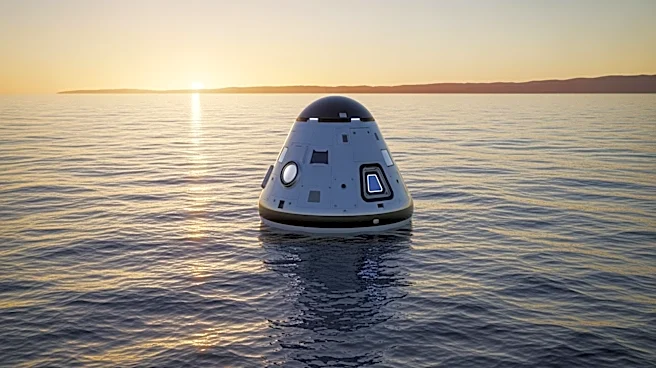
The Artemis II lunar mission, consisting of a four-member crew, is expected to conclude with a splashdown off the coast of Southern California. This marks the end of the first moon mission since the Apollo era in the 1970s. NASA and the U.S. Navy are
coordinating efforts to recover the astronauts and their Orion spacecraft using the amphibious dock ship U.S.S. John P. Murtha. The spacecraft has been thoroughly inspected for any damage that could affect the safety of the crew during reentry, and no concerns have been reported. The final phase of the mission involves the spacecraft entering Earth's atmosphere at a speed of approximately 23,840 mph, with the landing scheduled for 8:07 p.m. Eastern Time.
Why It's Important?
The successful completion of the Artemis II mission is a significant milestone for NASA, marking a new era of lunar exploration. It demonstrates the agency's capability to conduct complex space missions and paves the way for future endeavors, including potential manned missions to Mars. The mission's success is crucial for maintaining momentum in the U.S. space program and inspiring a new generation of scientists and engineers. Additionally, it reinforces the United States' leadership in space exploration, which has implications for international collaboration and competition in the space sector.
What's Next?
Following the splashdown, the crew and spacecraft will be retrieved by the U.S. Navy. The mission's success will likely lead to increased funding and support for NASA's Artemis program, which aims to establish a sustainable human presence on the Moon. Future missions may focus on lunar surface exploration and the development of technologies necessary for long-duration space travel. The Artemis program is also expected to foster international partnerships, as other countries express interest in participating in lunar exploration.