


What's Happening?
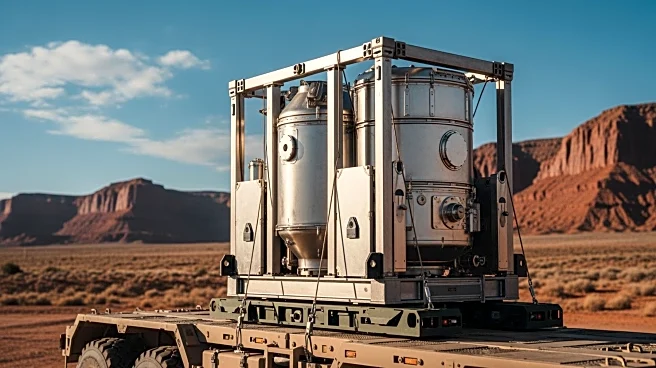
The U.S. military, in collaboration with the Department of Energy, has successfully airlifted a small nuclear reactor from March Air Reserve Base in Riverside County, California, to Utah. This marks the first time such a reactor has been transported by
air, highlighting the Trump administration's push to promote nuclear energy as a reliable power source. The reactor, a 5-megawatt microreactor built by Valar Atomics, was transported without nuclear fuel aboard a C-17 military aircraft. Energy Secretary Chris Wright and Undersecretary of Defense Michael Duffey accompanied the reactor, emphasizing the administration's efforts to fast-track commercial licensing for microreactors. This initiative is part of a broader strategy to reshape the U.S. energy landscape, focusing on nuclear power to meet increasing energy demands from sectors like artificial intelligence and data centers.
Why It's Important?
This development underscores a significant shift in U.S. energy policy under the Trump administration, which is prioritizing nuclear power as a carbon-free energy source. The ability to rapidly deploy microreactors could enhance energy security for military bases and potentially reduce reliance on civilian power grids. However, the initiative has faced criticism regarding the safety and economic feasibility of microreactors. Critics argue that the administration has not adequately addressed safety concerns, particularly regarding the secure transport of reactors once they are loaded with nuclear fuel. The success of this initiative could have far-reaching implications for the U.S. energy sector, potentially leading to a 'nuclear renaissance' as described by Energy Secretary Wright.
What's Next?
The microreactor transported to Utah will undergo testing and evaluation at the Utah San Rafael Energy Lab. Valar Atomics plans to begin selling power on a test basis next year, with full commercialization expected by 2028. The Energy Department is also in discussions with various states to establish sites for reprocessing fuel or handling nuclear waste disposal. The administration's push for nuclear energy is expected to continue, with further developments likely to focus on addressing safety concerns and securing regulatory approvals for broader deployment.
Beyond the Headlines
The airlift of the microreactor represents a broader trend towards innovation in nuclear technology, aiming to make nuclear power more adaptable and responsive to modern energy needs. This move could influence global energy strategies, as other nations observe the U.S. approach to integrating nuclear power into both military and civilian applications. Additionally, the initiative raises questions about the balance between advancing nuclear technology and ensuring environmental and public safety, a debate that will likely continue as the U.S. pursues its nuclear energy goals.