





What's Happening?
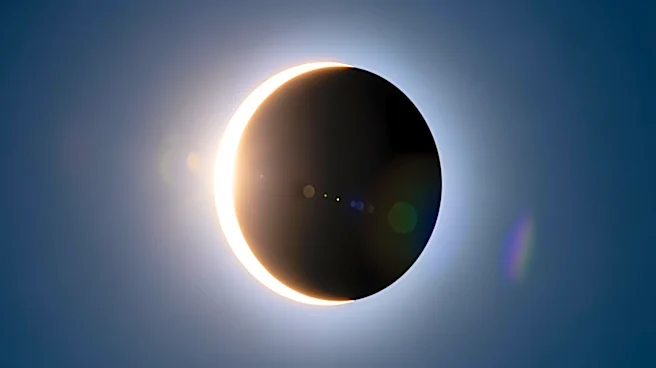
A partial solar eclipse is set to occur on August 12, 2026, and will be visible across parts of Europe, Africa, and North America, including the Midwest and New England in the United States. Indiana is among the states listed to witness this celestial
event, although the visibility will be minimal. According to Time and Date, the eclipse will begin around 1:16 p.m. in Fort Wayne, Indiana, where only 0.45% of the sun will be obscured. Residents in northeast Indiana, particularly those near Angola, might experience up to 1% of the eclipse. The best viewing locations in the U.S. are expected to be in New England, with areas like Freeport, Maine, experiencing up to 20% coverage. This event follows a total solar eclipse that passed over Indianapolis in April 2024.
Why It's Important?
The partial solar eclipse presents a unique opportunity for residents in Indiana and other parts of the U.S. to engage with astronomical phenomena, albeit with limited visibility in Indiana. Such events can spark interest in science and astronomy, encouraging educational activities and public engagement. While the eclipse in Indiana will be minor, it highlights the state's inclusion in a global event, fostering a sense of connection to broader natural cycles. Additionally, the anticipation of future eclipses, such as a larger partial eclipse in January 2029, can stimulate local tourism and community events centered around these occurrences.
What's Next?
For those interested in experiencing the eclipse more fully, traveling to regions with higher visibility, such as New England, might be considered. In Indiana, local observatories and educational institutions may organize viewing events or informational sessions to maximize public engagement. Looking ahead, Indiana residents can anticipate a more significant partial solar eclipse in January 2029, which will offer greater visibility and potentially more extensive community involvement.
Beyond the Headlines
The occurrence of solar eclipses serves as a reminder of the intricate dynamics of our solar system and the predictable nature of celestial events. These phenomena can inspire discussions about the importance of scientific literacy and the role of astronomy in understanding our place in the universe. Moreover, eclipses can have cultural significance, often being associated with myths and historical interpretations that vary across different societies.