





What's Happening?
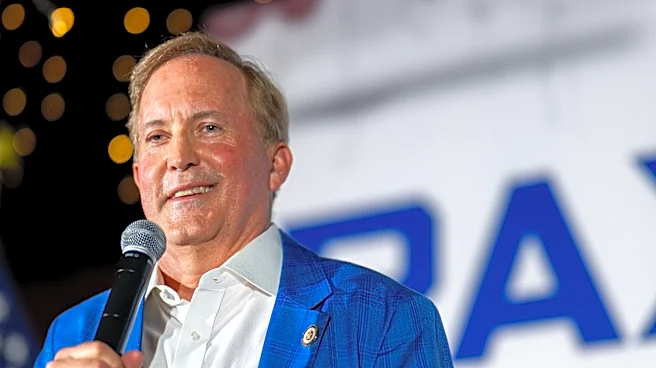
The race for Texas's U.S. Senate seat is proving to be one of the nation's most expensive, with Democratic nominee James Talarico significantly out-raising his Republican opponent, Ken Paxton. Talarico has raised $72.0 million since the beginning of 2025,
compared to Paxton's $16.8 million. Talarico's campaign ended June with $23.3 million on hand, more than triple Paxton's. Talarico has set records for fundraising at this stage, surpassing any general election nominee in Texas over the past decade. Despite Paxton's fundraising deficit, a recent Supreme Court ruling striking down federal limits on how much political parties can spend in coordination with candidates may benefit him, as Republicans are expected to gain more from stronger large-donor support at the national level. Talarico has also launched a significant $4.4 million ad campaign.
Why It's Important?
This significant disparity in fundraising highlights the intense financial investment in the Texas Senate race and its potential implications for the broader political landscape. Talarico's record-breaking fundraising indicates strong Democratic enthusiasm and donor support, suggesting a highly competitive contest in a state traditionally seen as Republican. The Supreme Court's ruling on coordinated spending could be a game-changer, potentially mitigating Paxton's fundraising disadvantage by allowing national Republican committees to inject substantial funds into his campaign. This dynamic could test the effectiveness of grassroots, small-donor fundraising versus large-scale party support. The outcome of this race could influence the balance of power in the U.S. Senate and serve as a bellwether for future elections, demonstrating whether financial advantage or coordinated party spending holds more sway.
What's Next?
The Texas Senate race is expected to intensify as both campaigns leverage their resources in the coming months. Talarico will likely continue his aggressive fundraising and advertising efforts, aiming to capitalize on his momentum and small-donor support. Paxton, despite his fundraising deficit, will likely lean heavily on the new Supreme Court ruling, coordinating closely with national Republican party committees to boost his campaign spending. This could lead to a surge in pro-Paxton advertising and ground operations funded by national party organizations. The effectiveness of these coordinated efforts will be a key factor to watch. The race will also likely see increased independent expenditures, with super PACs continuing to play a significant role in supporting or opposing candidates, further escalating the financial stakes.
Beyond the Headlines
The financial dynamics of the Texas Senate race reflect a broader trend in U.S. politics where campaign finance rules and donor strategies significantly shape electoral outcomes. Talarico's success with small-dollar donors points to the growing power of grassroots movements and digital fundraising in mobilizing support. Conversely, Paxton's reliance on national party coordination, facilitated by the Supreme Court ruling, underscores the enduring influence of large donors and established party structures. This election could serve as a case study for the evolving landscape of campaign finance, examining how different funding models impact candidate viability and electoral competitiveness. It also raises questions about the fairness and transparency of campaign spending, particularly concerning the role of super PACs and coordinated party expenditures, and their potential to overshadow individual candidate fundraising efforts.