

What's Happening?
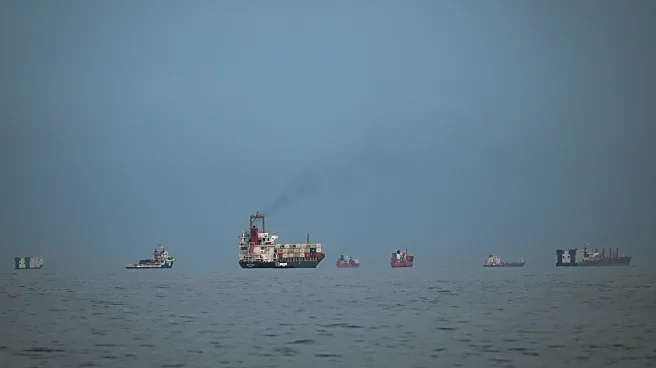
Despite ongoing military actions by the United States and Israel, Iran's oil exports continue largely uninterrupted. Satellite imagery from the European Space Agency shows tankers at Iran's Kharg Island, a major oil export hub, indicating that the country's
energy trade remains active. The U.S. Treasury Secretary Scott Bessent confirmed that the U.S. is allowing Iranian oil tankers to exit the Strait of Hormuz unchallenged to help stabilize global oil prices. This decision comes as the U.S. and its allies face increased pressure to manage soaring oil prices due to the conflict. Iran's oil exports are crucial to its economy, heavily sanctioned by international entities, with a significant portion of its crude going to China.
Why It's Important?
The U.S. decision to allow Iranian oil exports is a strategic move to mitigate the impact of the conflict on global oil prices. By permitting these exports, the U.S. aims to prevent further economic destabilization that could arise from skyrocketing oil prices. This approach highlights the complex geopolitical dynamics at play, where economic considerations are balanced against military actions. The continuation of Iranian oil exports also underscores the global dependency on Middle Eastern oil, particularly through the Strait of Hormuz, a critical chokepoint for global energy supplies. The situation reflects the broader challenges of maintaining energy security amidst geopolitical tensions.
What's Next?
The ongoing conflict and the U.S.'s strategic decisions will likely continue to influence global oil markets. The U.S. may seek further international cooperation to ensure the Strait of Hormuz remains open, potentially involving other major oil-importing nations like China and India. The situation could also prompt discussions on diversifying energy sources and reducing dependency on Middle Eastern oil. Additionally, the geopolitical landscape may shift as countries reassess their alliances and strategies in response to the conflict's economic and political ramifications.