



What's Happening?
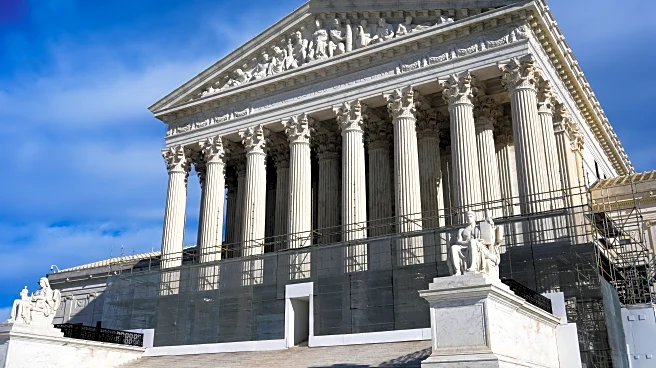
The U.S. Supreme Court has issued a significant ruling that curtails President Trump's authority to impose and remove tariffs, marking a pivotal moment in the ongoing tension between the executive branch and the judiciary. The 6-3 decision underscores
the constitutional limits of presidential power, particularly in the realm of taxation, which the framers of the Constitution allocated to Congress. This ruling comes after a period where the conservative-majority court has largely supported Trump's initiatives. However, the court's decision reflects a clear message that it will not serve as a mere rubber stamp for the president's actions. The ruling specifically challenges Trump's interpretation of the 1977 emergency-powers law, which he used to justify his global tariff policies. Chief Justice John Roberts, writing for the majority, emphasized the need for clear congressional authorization for such sweeping executive actions.
Why It's Important?
This ruling is crucial as it reaffirms the separation of powers, a foundational principle of the U.S. Constitution. By limiting the president's tariff powers, the Supreme Court is reinforcing the role of Congress in taxation and trade policy, potentially affecting future executive actions. The decision could have significant implications for U.S. economic policy and international trade relations, as tariffs are a critical tool in these areas. It also signals to the executive branch that the judiciary will uphold constitutional boundaries, which may influence how future administrations approach similar issues. The ruling may impact stakeholders in industries reliant on international trade, as it introduces a level of uncertainty regarding the stability and predictability of U.S. tariff policies.
What's Next?
Following the ruling, President Trump has expressed strong disapproval, labeling the decision as 'anti-American' and increasing his proposed tariffs from 10% to 15%. This reaction suggests potential further legal and political battles as the administration seeks to navigate the constraints imposed by the court. The Supreme Court is expected to address additional cases concerning Trump's executive powers, including issues related to birthright citizenship and the firing of Federal Reserve officials. These upcoming decisions could further define the scope of presidential authority and influence the balance of power between the branches of government.