





What's Happening?
NASA is offering the public an opportunity to have their names flown aboard the Dragonfly rotorcraft mission to Saturn’s largest moon, Titan. This initiative, part of the 'Journey to Titan' campaign, allows individuals to submit their names to be etched
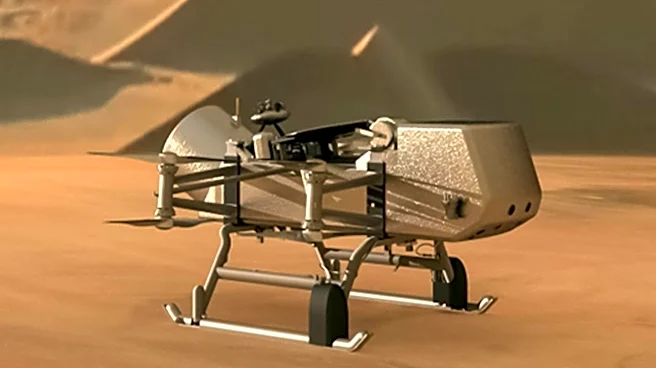
onto a microchip that will travel with the spacecraft. Participants will also receive a personalized digital boarding pass. The Dragonfly mission is the first-ever rotorcraft science mission designed to explore the surface of another world. Nicky Fox, associate administrator for the Science Mission Directorate at NASA Headquarters, highlighted the mission's goal to search for signs of habitability on Titan, which shares similarities with Earth. The deadline for name submissions is January 15, 2027, at 11:59 p.m. EST. The Dragonfly rotorcraft is currently under assembly at the Johns Hopkins Applied Physics Laboratory (APL) in Laurel, Maryland.
Why It's Important?
This public engagement initiative by NASA is significant for fostering public interest and participation in space exploration. By allowing individuals to symbolically join the Dragonfly mission, NASA aims to inspire a new generation in science, technology, engineering, and mathematics (STEM). The mission itself holds immense scientific importance, as Titan is a unique celestial body with a thick atmosphere, liquid methane rivers and lakes, and a landscape rich in organic materials. Exploring Titan could provide crucial insights into prebiotic chemistry—the chemical processes that preceded the emergence of life—and help scientists better understand the conditions necessary for life beyond Earth. The data collected by Dragonfly could revolutionize our understanding of planetary evolution and the potential for life in the universe, impacting astrobiology and planetary science research.
What's Next?
The Dragonfly mission is scheduled to launch in 2028 and is expected to arrive at Titan in 2034. Upon arrival, the rotorcraft will conduct multiple flights to various locations on the moon, exploring its diverse environments. The mission's primary objective is to investigate Titan's chemistry and search for clues related to prebiotic conditions. The Johns Hopkins Applied Physics Laboratory (APL) is leading the mission, with Elizabeth Turtle of APL serving as the principal investigator. Dragonfly is the fourth mission in NASA’s New Frontiers Program, managed by NASA’s Marshall Space Flight Center. The public can continue to submit their names until the specified deadline, and further updates on the mission's progress, including assembly and testing phases, are anticipated as the launch date approaches.
Beyond the Headlines
The Dragonfly mission represents a significant leap in robotic planetary exploration, utilizing a rotorcraft for the first time to navigate an extraterrestrial environment. This approach offers unprecedented flexibility in exploring diverse terrains and could pave the way for future aerial missions to other worlds with atmospheres. The focus on prebiotic chemistry on Titan also touches upon fundamental questions about the origins of life, potentially offering insights into Earth's early history. The mission's success could influence future funding and strategic planning for NASA's science missions, emphasizing the value of innovative exploration methods and the search for life beyond Earth. The public engagement aspect also highlights a growing trend in space agencies to connect global citizens directly with scientific endeavors, fostering a sense of shared human enterprise in exploring the cosmos.