
What's Happening?
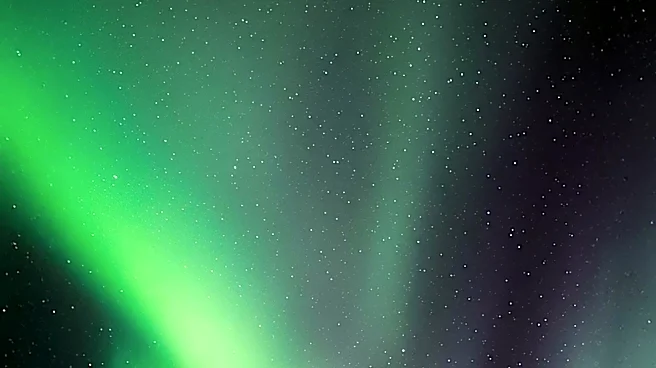
The Northern Lights, or aurora borealis, are becoming more frequently visible in Washington state, a phenomenon attributed to increased solar activity. According to NASA, auroras are created when energetic
space particles from solar wind collide with atoms and molecules in Earth's atmosphere, causing them to glow. While typically seen in high-latitude regions, strong geomagnetic storms can push this activity farther south, making the lights visible in areas like Washington. The U.S. National Oceanic and Atmospheric Administration (NOAA) Space Weather Prediction Center uses the Planetary K-index (Kp-index) to measure geomagnetic activity, with higher values indicating a greater chance of aurora visibility at lower latitudes. The current solar cycle is at its peak, contributing to the enhanced auroral displays.
Why It's Important?
The increased visibility of the Northern Lights in Washington state holds significant importance for public engagement with science and tourism. For residents, it offers a unique opportunity to witness a natural spectacle typically reserved for more northern regions, fostering a greater appreciation for atmospheric and space science. From a tourism perspective, this phenomenon can attract visitors to specific dark-sky locations within the state, potentially boosting local economies. Educational institutions, such as the Pierce College Science Dome, are leveraging this interest to offer programs that explain the science behind auroras, enhancing scientific literacy. However, challenges like light pollution and cloud cover remain, requiring careful planning for optimal viewing.
What's Next?
As the solar cycle continues at its peak, the likelihood of seeing the Northern Lights in Washington state is expected to remain elevated. Organizations like NOAA will continue to provide real-time forecasts and alerts, including the Kp-index and Aurora Viewline, to help the public track potential sightings. Amateur astronomers and local communities are encouraged to utilize these resources and seek out dark-sky locations away from city lights for the best viewing opportunities. Educational programs and outreach efforts will likely continue to capitalize on this natural event to promote interest in astronomy and space weather. The focus will be on informing the public about optimal viewing conditions and responsible stargazing practices.
Beyond the Headlines
The enhanced visibility of the Northern Lights in Washington state underscores the dynamic interaction between the sun and Earth's magnetosphere. This phenomenon is not merely a beautiful display but a tangible manifestation of space weather, which can have broader implications for technology and infrastructure, such as satellite communications and power grids. Understanding and predicting these events are crucial for safeguarding modern society. Furthermore, the cultural and historical significance of the aurora, dating back to ancient mythologies and scientific observations by figures like Galileo Galilei, adds a rich layer to its contemporary appreciation. The current solar maximum provides a unique opportunity for both scientific study and public wonder, bridging ancient observations with modern scientific understanding.