
What's Happening?
In 2025, three remarkable comets—3I/ATLAS, C/2025 A6 (Lemmon), and C/2025 R2 (SWAN)—captured the attention of skywatchers worldwide. 3I/ATLAS, identified on July 1, 2025, by the NASA-funded ATLAS telescope,
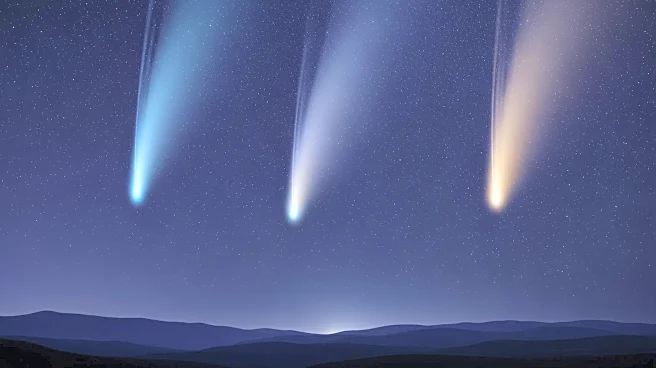
is the third known interstellar object to enter our solar system. Its mysterious origin sparked curiosity and speculation. The Hubble Space Telescope revealed it as the brightest and possibly most massive interstellar object observed, estimated to be 3.5 miles across. Comet Lemmon, discovered on January 3, 2025, became a favorite for astrophotographers due to its brightness and visibility to the naked eye. Comet SWAN impressed observers with its passage in front of the Eagle Nebula, creating stunning visual displays.
Why It's Important?
The appearance of these comets provided significant opportunities for scientific study and public engagement. 3I/ATLAS, as an interstellar object, offers insights into material from other star systems, enhancing our understanding of the universe. Comet Lemmon's visibility and brightness allowed for widespread observation and documentation, contributing to public interest in astronomy. The visual spectacle of Comet SWAN against the Eagle Nebula highlighted the beauty and complexity of cosmic phenomena, inspiring both scientists and the public.
What's Next?
As these comets continue their journeys, scientists will analyze the data collected to deepen their understanding of cometary behavior and composition. The findings from these observations may lead to new theories about the formation and evolution of comets. Public interest in these celestial events may encourage further engagement with astronomy and space exploration, fostering a greater appreciation for the wonders of the universe.
Beyond the Headlines
The fascination with these comets underscores the enduring human interest in celestial phenomena and the quest for knowledge about the cosmos. The study of interstellar objects like 3I/ATLAS challenges existing scientific paradigms and opens new avenues for exploration. The public's engagement with these events highlights the role of astronomy in inspiring curiosity and wonder, bridging the gap between scientific discovery and cultural appreciation.