
What's Happening?
President Trump has established a rapid-approval system for National Park Service (NPS) projects he personally prioritizes, particularly those in the Washington D.C. area. This system, created through
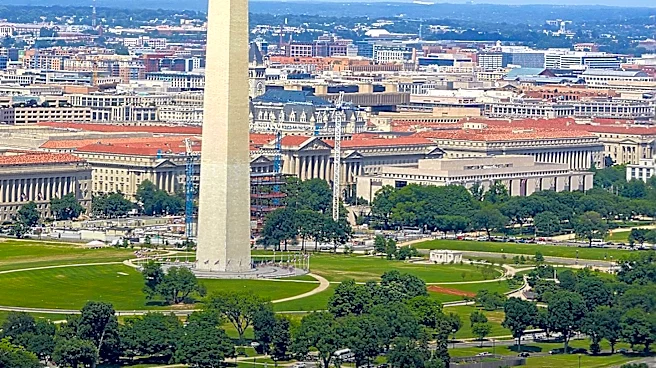
an executive order to make the District of Columbia “safe and beautiful,” has led to a separate docket of “White House priorities” that receive expedited funding and contracting resources. Examples include a $1.5 million project to replace brick pavers in Lafayette Park, a $170,000 request to remove a fence at Hains Point golf course, and a more than $5 million project to gild equine statues along the Memorial Bridge. These projects are handled separately from other park initiatives, which are categorized into 'high priorities' and 'low priorities.' Internal NPS documents indicate that projects on the low-priority list are unlikely to be completed. This prioritization has resulted in significant spending increases around Washington D.C., while spending on projects in park regions outside the capital has decreased by $854 million, or 68%, in the first eight and a half months of fiscal year 2026 compared to the previous fiscal year.
Why It's Important?
This shift in prioritization has significant implications for the National Park Service and the preservation of national parks across the U.S. By funneling resources and attention to projects favored by President Trump, other vital needs in numerous national parks are being neglected. This includes requests for wildlife-resistant dumpsters in Bryce Canyon National Park, snow machines for fire remediation in Alaska’s Yukon–Charley Rivers National Preserve, and archaeological surveys at Camp Nelson National Monument. The internal documentation for park projects typically includes 'Consequences of Failure to Act,' which scores urgency based on health and safety measures, yet these are being bypassed for the White House's preferred projects. Furthermore, the NPS workforce has seen significant reductions, with 179 full-time administrative officers in June, a 21% decrease since President Trump took office. This lack of staff, particularly contracting managers, exacerbates the backlog of unfinished projects in parks outside Washington D.C., leading to concerns about the long-term maintenance and operational capacity of the nationwide park system.
What's Next?
The future of funding for National Park Service projects remains uncertain, particularly for those not on the White House priority list. It is unclear if all projects on the White House's list will receive funding this fiscal year, which also includes a $25 million plan for a new U.S. Park Police helicopter, $475,000 for White House exterior cleaning, and drones for law enforcement in the Washington region. President Trump continues to add or expand projects on this priority list, such as further deliberations on the type of pavers for Lafayette Park. Park superintendents and employees are expressing frustration, with some reporting that their facilities are still awaiting promised operating-support funding and that additional routine-maintenance funding will not arrive. The ongoing workforce reductions and lack of contracting staff suggest that the backlog of projects in far-flung parks will likely continue to grow, potentially leading to further deterioration of infrastructure and services in these areas. Stakeholders anticipate continued challenges in securing resources for non-priority projects and maintaining essential operations.
Beyond the Headlines
The current approach to National Park Service funding raises deeper questions about the balance between presidential prerogative and the broader mission of preserving national treasures. The creation of a separate, prioritized docket for projects favored by President Trump, coupled with significant workforce reductions, suggests a centralization of control and a potential politicization of resource allocation within a federal agency. This could set a precedent where the maintenance and development of national parks become subject to the personal interests of an administration rather than a comprehensive assessment of national needs. The ethical implications extend to the potential neglect of historically significant sites and natural landscapes that do not align with immediate political objectives. The long-term shift could undermine the NPS's ability to fulfill its mandate of preserving natural and cultural resources for future generations, leading to a decline in the quality and accessibility of parks nationwide, and potentially impacting tourism and local economies dependent on these sites.