





What's Happening?
Astronomers, policymakers, and space agencies are increasingly concerned about the rapid expansion of satellite networks around Earth, leading to a new space crisis. Thousands of satellites are already in orbit, and planned mega-constellations are expected
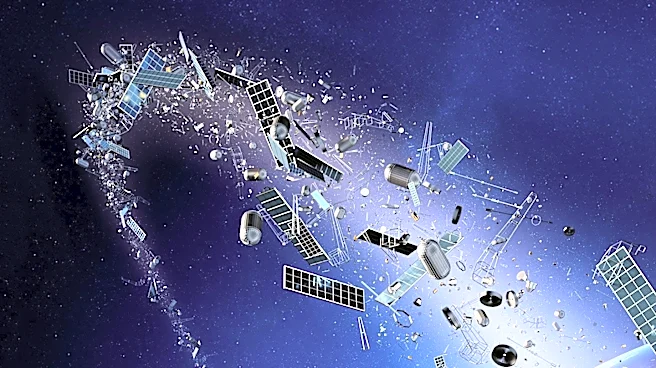
to significantly increase this number. This surge in orbital objects poses several challenges, including potential impacts on astronomical observations, increased risks of collisions, and greater complexity in managing space traffic. Astronomers rely on dark and stable skies to study celestial phenomena, but a growing number of reflective satellites can create streaks across telescope images, necessitating adaptations in observation methods and the development of new technologies. The issue extends beyond astronomy, as more objects in orbit heighten the risk of debris-generating collisions, which could threaten other missions and render certain orbital regions unusable.
Why It's Important?
The rapid proliferation of satellites has profound implications for scientific research, space safety, and international cooperation. For astronomers, the degradation of dark skies threatens fundamental research into distant galaxies and cosmic phenomena, potentially hindering our understanding of the universe. The increased risk of orbital collisions could lead to a cascade effect, generating more space debris and making space access more hazardous and costly for all nations and commercial entities. This situation highlights a critical need for updated international regulations and coordination, as current systems were designed for an era with far fewer operational spacecraft. The challenge lies in balancing commercial growth and technological advancement with the long-term sustainability and safety of Earth's orbital environment, affecting global communication, navigation, and scientific endeavors.
What's Next?
The international community faces the urgent task of developing stronger coordination and new regulatory frameworks to manage the increasingly crowded orbital environment. Discussions within forums like the United Nations Committee on the Peaceful Uses of Outer Space (COPUOS) are crucial, though achieving consensus among many nations with differing priorities remains a significant challenge. Legal experts are exploring avenues such as the International Court of Justice (ICJ) to shape diplomatic conversations and encourage cooperation, even if the ICJ lacks direct enforcement mechanisms. The coming years will likely see intensified negotiations between governments, private companies, and scientific organizations to establish common standards for satellite operations, debris prevention, and orbital sustainability. The decisions made now will determine the future usability of Earth's orbit for generations.
Beyond the Headlines
Beyond the immediate concerns of collision risks and observational interference, the rapid filling of Earth's orbit raises deeper questions about humanity's stewardship of shared global resources. Space, once considered an infinite frontier, is now demonstrating its finite capacity, particularly in desirable orbital paths. This situation underscores the ethical responsibility of current generations to ensure the long-term accessibility and safety of space for future scientific, economic, and exploratory endeavors. The challenge also highlights the complexities of international governance in a rapidly evolving technological landscape, where commercial interests often outpace regulatory development. The need for global cooperation in space management could serve as a model or a cautionary tale for addressing other transnational issues, such as climate change or resource depletion, emphasizing the interconnectedness of human activities and their environmental impacts.