





What's Happening?
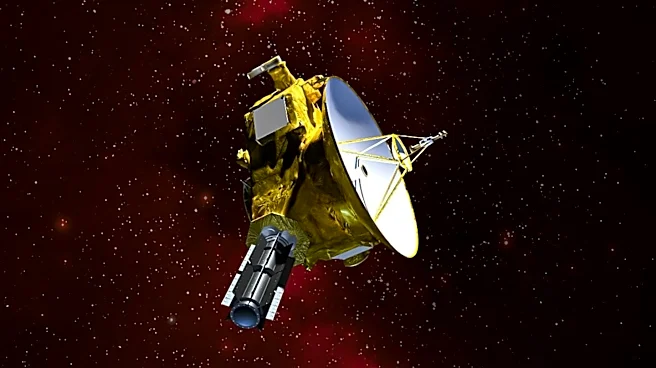
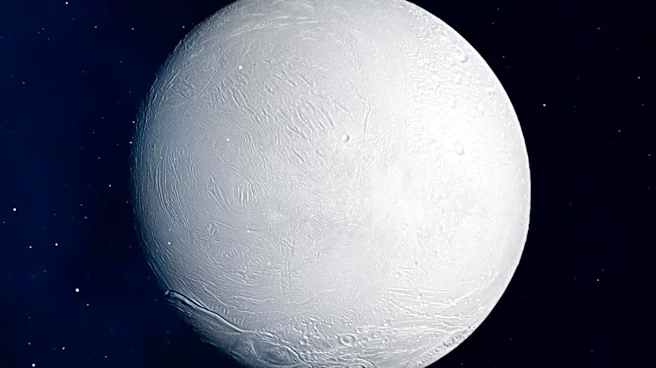
NASA's Cassini spacecraft has provided significant insights into Saturn's moon Enceladus, revealing that it emits a plume of water vapor and ice grains through fractures near its south pole, known as the tiger stripes. This plume, which Cassini sampled
multiple times between 2005 and 2015, contains molecular hydrogen, a potential chemical fuel for life. The presence of molecular hydrogen suggests that Enceladus's subsurface ocean may have conditions similar to Earth's deep-sea hydrothermal vents, where life thrives without sunlight. Recent studies have also identified a range of organic compounds and phosphates in the plume, indicating that Enceladus possesses five of the six elements essential for life as we know it.
Why It's Important?
The findings from Cassini's mission are crucial as they suggest that Enceladus has the necessary ingredients to support microbial life. The presence of molecular hydrogen and organic compounds in the moon's plume points to a habitable environment, although not necessarily an inhabited one. This discovery expands our understanding of where life might exist beyond Earth and highlights the potential for life in environments previously considered inhospitable. The research underscores the importance of continued exploration of celestial bodies within our solar system to uncover the mysteries of life beyond Earth.
What's Next?
While Cassini's mission ended in 2017, the data it collected continues to yield new insights. However, to determine if life exists on Enceladus, a new mission equipped with modern instruments capable of directly detecting life is necessary. Both NASA and the European Space Agency have considered concepts for future missions to Enceladus, but none are currently funded or scheduled. Until such a mission is launched, the question of whether Enceladus's ocean is inhabited remains open.
Beyond the Headlines
The discovery of life-supporting conditions on Enceladus raises ethical and philosophical questions about the implications of finding life beyond Earth. It challenges our understanding of life's uniqueness and prompts discussions about the protection of extraterrestrial ecosystems. Additionally, the technological advancements required for future missions to Enceladus could drive innovation in space exploration and related fields.