

What's Happening?
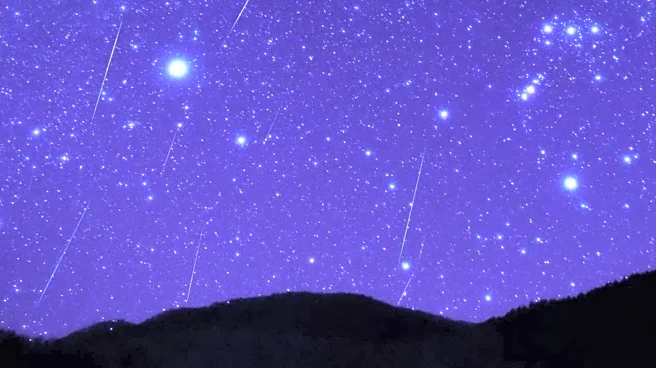
The bright star Vega, located in the constellation Lyra, is now visible above the horizon by midnight, marking a significant event for sky watchers as spring transitions into summer. Vega, cataloged as Alpha Lyrae, is the fifth-brightest star in the sky and
forms one point of the Summer Triangle asterism, alongside Deneb in Cygnus and Altair in Aquila. This star is notable for its brightness and its position, which allows it to rise earlier each day as the season progresses. Vega is about twice as massive as the Sun and nearly 40 times as luminous, despite being much younger at 400 million years old. Its orientation in space is unique, with its pole pointed nearly directly toward Earth, causing a phenomenon known as gravity darkening, where the poles appear hotter and brighter than the equator.
Why It's Important?
The visibility of Vega is significant for astronomers and sky enthusiasts as it signals the arrival of summer constellations. Vega's brightness and position make it a key navigational star, aiding in the study of stellar evolution due to its mass and luminosity. Its unique orientation provides a rare opportunity to observe gravity darkening, offering insights into stellar dynamics and structure. This event also enhances public interest in astronomy, encouraging educational and observational activities related to the night sky.
What's Next?
As Vega continues to rise earlier each night, it will become a prominent feature in the summer sky, providing ongoing opportunities for observation and study. Astronomers and enthusiasts will likely focus on the Summer Triangle, using Vega as a reference point for locating other celestial objects. Educational programs and public events may increase, leveraging Vega's visibility to promote interest in astronomy and science education.
Beyond the Headlines
Vega's rising not only marks a seasonal change but also highlights the dynamic nature of our universe. Its gravity darkening phenomenon challenges traditional perceptions of stellar appearance and behavior, prompting further research into the effects of rotation on star shapes and brightness. This event underscores the importance of continuous observation and study of celestial bodies to enhance our understanding of the cosmos.