







What's Happening?
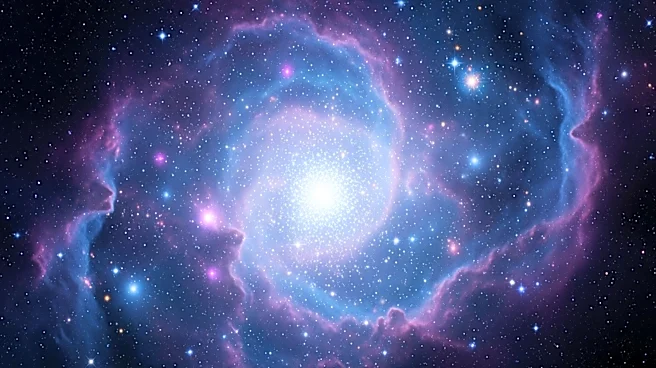
NASA's James Webb Space Telescope has provided new insights into the formation of star clusters, as revealed in a recent study. The telescope observed nearly 9,000 star clusters, focusing on the spiral arms of Messier 51 (M51), a nearby galaxy. The data
indicates that more massive star clusters emerge more quickly from their birth clouds. This research is crucial for understanding galactic evolution, the dynamics within galaxies, and the processes of planet formation. The study highlights the capabilities of the James Webb Space Telescope in advancing our knowledge of the universe.
Why It's Important?
The findings from the James Webb Space Telescope are significant for several reasons. Understanding star cluster formation is essential for comprehending the broader processes of galactic evolution and the formation of planetary systems. This knowledge can inform models of how galaxies develop and change over time, impacting our understanding of the universe's history and future. Additionally, the insights gained can aid in identifying regions within galaxies where planets are likely to form, potentially guiding future astronomical research and exploration.