





What's Happening?
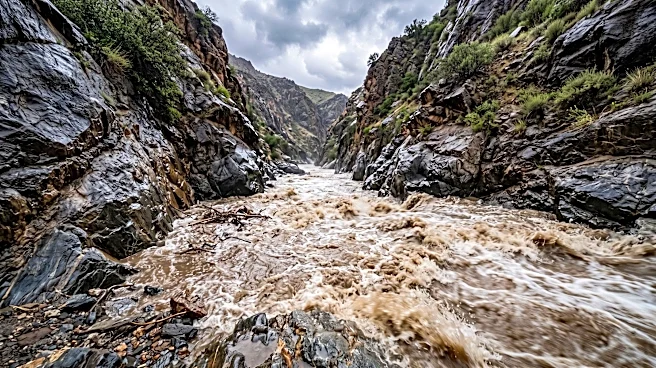
Researchers at Penn State University are applying artificial intelligence (AI) techniques, similar to those used for generating images, to improve the prediction of flash floods. Flash floods, which account for approximately 85% of all floods and cause
thousands of deaths globally each year, are notoriously difficult to forecast due to their rapid onset and recession. Chaopeng Shen, a professor of civil and environmental engineering and lead author, and his team have been developing machine learning and AI models for flood forecasting. While previous national-scale models accurately predicted floods using historical rainfall and streamflow data, they struggled with the severity of rapid weather changes that trigger flash floods. The new approach, detailed in a paper published in Water Resources Research, trains the AI model using diffusion, a method common in image generation. This involves introducing noise into complete datasets of rainfall and streamflow data from over 500 river basins across the continental U.S. (1990-2003) and then training the AI to remove the noise and reproduce interpretable data. This method allows the model to better handle the unpredictable nature of hourly rainfall and quantify uncertainty in predictions, making it more reliable for capturing the extraordinary peaks of flash floods.
Why It's Important?
This advancement in AI-driven flood prediction holds significant importance for public safety and disaster preparedness in the U.S. Flash floods can devastate communities within minutes, causing substantial damage and loss of life. Improved hourly prediction capabilities mean that emergency services and residents can receive more timely and accurate warnings, allowing for better evacuation planning and resource allocation. This could lead to a reduction in fatalities and economic losses associated with these catastrophic events. The ability to assimilate real-time gauge observations into the model without retraining, a process known as inpainting, further enhances its practical utility, providing up-to-the-minute risk assessments. For industries, particularly agriculture and infrastructure, more precise flood forecasts can help mitigate damage to crops, property, and transportation networks. The research also highlights the broader potential of generative AI techniques, demonstrating their applicability beyond creative tasks to critical environmental and safety challenges, potentially opening new avenues for scientific research and technological development in disaster management.
What's Next?
The immediate next steps for this research will likely involve further refinement and validation of the AI model. Researchers will continue to test its accuracy with new and diverse datasets, potentially expanding its application to a wider range of geographical areas and hydrological conditions across the U.S. Collaboration with national weather services and emergency management agencies could facilitate the integration of this advanced forecasting tool into existing early warning systems. This would involve developing user-friendly interfaces and protocols for disseminating the hourly flood predictions to relevant stakeholders and the public. Additionally, future research may explore how to incorporate other environmental factors, such as soil saturation levels and topographical data, to further enhance the model's predictive power. The success of this approach could also inspire the application of similar AI techniques to predict other natural disasters, such as wildfires or landslides, leading to a more comprehensive and proactive disaster management framework.
Beyond the Headlines
The application of AI techniques, traditionally used for image generation, to complex environmental modeling like flood prediction, signifies a broader trend in scientific innovation. This interdisciplinary approach underscores the versatility of AI and its potential to solve real-world problems in unexpected ways. It also raises questions about the future of scientific discovery, where AI might increasingly act as a powerful tool for pattern recognition and data interpretation in fields previously dominated by traditional statistical methods. Ethically, the development of more accurate flood prediction models carries a responsibility to ensure equitable access to these warnings, particularly for vulnerable communities that are often disproportionately affected by natural disasters. The reliance on AI also necessitates transparency in its algorithms and continuous evaluation to prevent biases and ensure reliability. Furthermore, this development could spur greater investment in data collection infrastructure, such as advanced sensor networks for rainfall and streamflow, to feed these sophisticated AI models, thereby creating a more robust national system for environmental monitoring and disaster resilience.