


What's Happening?
Researchers at the University of Rochester have developed a new, lower-cost imaging system capable of seeing through challenging environments such as deep tissue and dense fog. This system addresses limitations of existing near-infrared imaging technologies,
which often struggle with scattering effects in such conditions and rely on expensive specialized detectors. The new technology utilizes inexpensive silicon-based detectors and quickly converts near-infrared light to visible light, producing clearer images. The core of this innovation is a time-gating technique, refined over a decade by the laboratory of Robert Boyd, the William F. Krupke Distinguished Professor in Optics. This technique functions like a camera shutter, using ultrafast bursts of light to allow infrared photons through a gate for only about a picosecond. The gate itself is a thin film made of indium tin oxide, which converts the near-infrared photons into visible light in real-time. The research, led by Yang Xu, was published in Nature Communications.
Why It's Important?
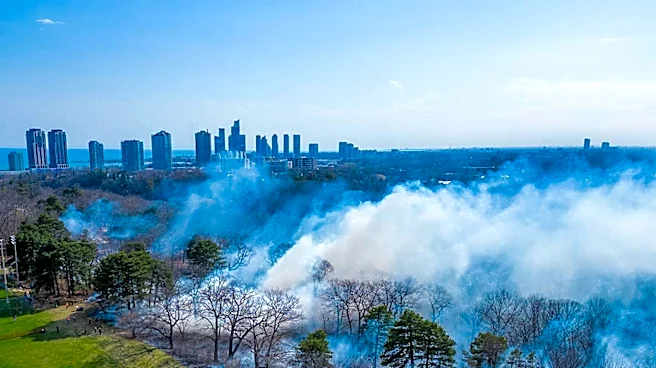
This advancement holds significant implications for various U.S. industries and public policy, particularly in healthcare and autonomous vehicle technology. In biomedical imaging, the ability to achieve clearer images through deep tissue could enhance cancer detection and diagnosis, potentially leading to earlier interventions and improved patient outcomes. For the autonomous vehicle sector, the system's capacity to see through dense fog and other light-scattering conditions could dramatically improve the reliability and safety of LiDAR (light detection and ranging) systems. This could accelerate the development and deployment of self-driving cars, reducing accidents caused by poor visibility. The lower cost of the silicon-based detectors also makes this technology more accessible and scalable, potentially broadening its adoption across different applications and making advanced imaging more affordable for healthcare providers and technology companies. Furthermore, the integration of artificial intelligence to expand the system's field of view, as detailed in a paper in Light: Science & Applications, suggests a pathway to even more robust and versatile imaging solutions.
What's Next?
The University of Rochester researchers, including Yang Xu and Professor Robert Boyd, are continuing to refine their time-gating imaging system. Future developments are expected to focus on further enhancing image quality and expanding the system's capabilities. The collaboration with UCLA researchers to integrate machine learning has already demonstrated the potential to dramatically enlarge the system's field of view, suggesting that further AI integration will be a key area of focus. This could lead to more comprehensive and detailed imaging for various applications. The next steps will likely involve further testing and validation of the technology in real-world scenarios, particularly in clinical settings for medical diagnostics and in diverse environmental conditions for autonomous vehicle applications. Commercialization efforts may also follow, as the lower cost and improved performance of this system make it an attractive alternative to current imaging solutions. Continued research will explore additional materials and techniques to optimize the conversion of near-infrared to visible light and improve the precision of the time-gating mechanism.
Beyond the Headlines
The development of this advanced imaging system touches upon broader implications concerning technological accessibility and the ethical considerations of AI integration in critical applications. By utilizing inexpensive silicon-based detectors, the technology has the potential to democratize access to high-fidelity imaging, making advanced diagnostic tools more available in underserved communities and reducing healthcare disparities. This shift could also impact the economic landscape of medical device manufacturing, fostering competition and innovation. Furthermore, the integration of artificial intelligence to expand the system's field of view raises important questions about the role of AI in interpreting and enhancing visual data. While AI can significantly improve performance, ensuring the accuracy, reliability, and ethical deployment of AI in medical diagnostics and autonomous driving is paramount. This includes addressing potential biases in AI algorithms and establishing clear regulatory frameworks for AI-enhanced imaging systems to maintain public trust and safety. The long-term impact could be a paradigm shift in how we perceive and interact with our environment, both medically and technologically.