




What's Happening?
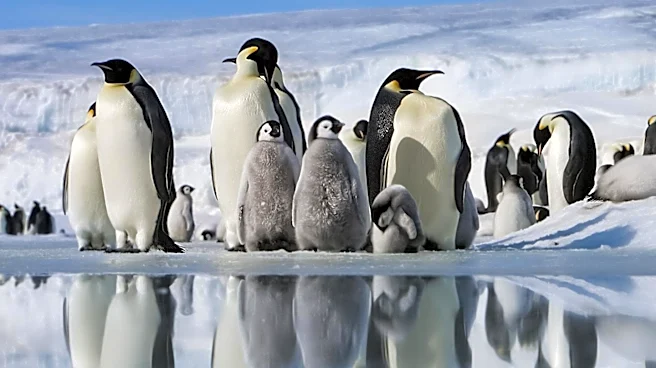
A study announced by the Woods Hole Oceanographic Institution (WHOI) on November 17 revealed that young emperor penguins frequently cross industrial krill fishing grounds during their crucial first year at sea. The international team tracked 48 juvenile
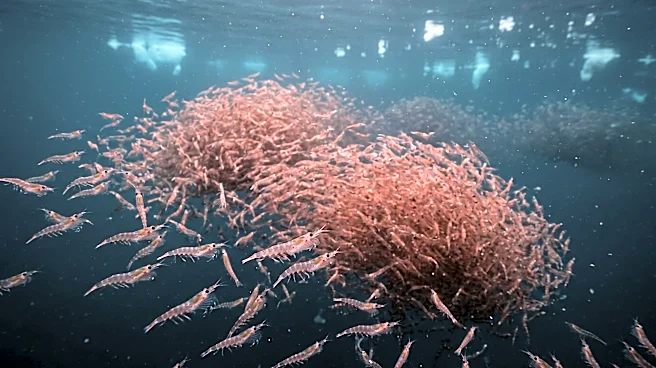
emperor penguins from three colonies around the Weddell Sea: Snow Hill Island, Jason Peninsula, and Atka Bay. The research, published in the journal Biological Conservation, found that juveniles from Jason Peninsula spent over 60% of their time in recently fished zones during February and March. This finding strengthens the argument for establishing new marine protected areas around Antarctica. Most fishing in these regions targets Antarctic krill, a vital food source for emperor penguins and other Antarctic species. The study highlights a consistent migration pattern among young penguins, who travel more than 1,500 kilometers and spend a full year at sea, often traversing areas with high fishing activity.
Why It's Important?
This research is critical because it identifies a direct overlap between the vulnerable early life stages of emperor penguins and industrial krill fishing operations. Emperor penguins are a keystone species, and their populations are already under severe threat from climate change, with predictions of a halving by the 2080s due to sea ice changes. The first year at sea is particularly perilous for juvenile penguins, with only about a third surviving to adulthood. Increased fishing pressure in their feeding grounds not only reduces their primary food source, krill, but also increases the risk of bycatch. This situation exacerbates the challenges faced by an already endangered species and underscores the urgent need for effective marine protected areas. The study's findings provide scientific evidence that current protected areas, often planned around adult colonies, fail to cover the critical sea areas where juveniles spend their vulnerable early years, thus impacting the long-term survival of the species.
What's Next?
The findings from WHOI are expected to intensify calls for the establishment of new and expanded marine protected areas (MPAs) in the Antarctic, particularly in the Weddell Sea, which supports about one-third of the world's emperor penguins. For over a decade, efforts to create a vast MPA in the Weddell Sea, covering approximately 2.2 million square kilometers, have been stalled due to a lack of agreement among countries in the Commission for the Conservation of Antarctic Marine Living Resources (CCAMLR). This new evidence regarding juvenile penguin movements through fishing grounds could provide renewed impetus for these negotiations. Scientists and conservation organizations will likely use this data to advocate for more comprehensive protection strategies that consider the full life cycle and migratory patterns of emperor penguins. The focus will be on ensuring that any future fishing regulations or protected areas effectively safeguard both adult and juvenile penguins, as well as the broader Antarctic food web.
Beyond the Headlines
The intersection of juvenile emperor penguin migration routes with industrial krill fishing grounds reveals a complex challenge in global conservation efforts. It highlights the difficulty of implementing effective environmental policies in international waters, where diverse national interests often clash. The repeated failure of CCAMLR to agree on new protected areas, despite mounting scientific evidence of ecological threats, points to a governance gap that allows unsustainable practices to continue. This situation also underscores the interconnectedness of global ecosystems and human activities; the demand for krill in distant markets directly impacts the survival of iconic Antarctic species. The ethical dimension of exploiting a keystone species in a fragile ecosystem, especially when that ecosystem is already under stress from climate change, raises profound questions about humanity's stewardship of the planet. Addressing this issue requires not only scientific understanding but also political will and a global commitment to prioritize ecological health over short-term economic gains.