
What's Happening?
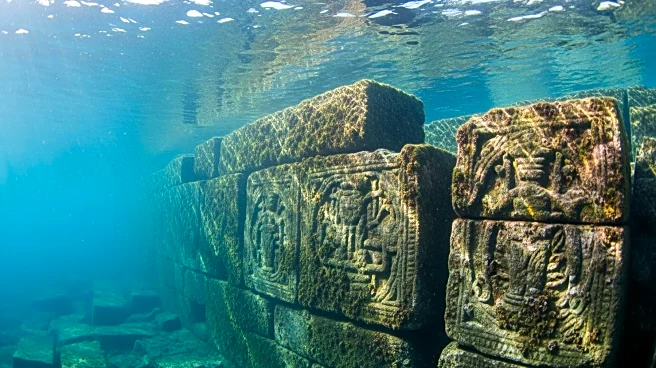
A 7,000-year-old submerged wall has been discovered off the coast of Brittany, France, by divers. The wall, along with a dozen smaller structures, dates back to between 5,800 and 5,300 BC. These structures, found
nine meters underwater, are believed to have served as fish traps or sea defenses. The discovery, led by archaeologist Yvan Pailler and first identified by retired geologist Yves Fouquet, highlights the advanced technical skills and social organization of prehistoric coastal societies. The structures predate known megalithic monuments in the region, offering new insights into early human engineering and societal structures.
Why It's Important?
This discovery provides significant insights into the capabilities and social organization of prehistoric societies. The technical skills required to construct such large structures suggest a level of sophistication previously underestimated for this period. Understanding these early engineering feats can reshape historical narratives about human development and adaptation to environmental changes. The findings also contribute to the field of underwater archaeology, opening new avenues for research into ancient coastal communities and their interactions with changing sea levels.