



What's Happening?
The Standard Model of particle physics, while successful, does not account for dark matter, leading to theories like the dark sector theory. This theory proposes the existence of new particles that interact weakly with Standard Model particles. A key
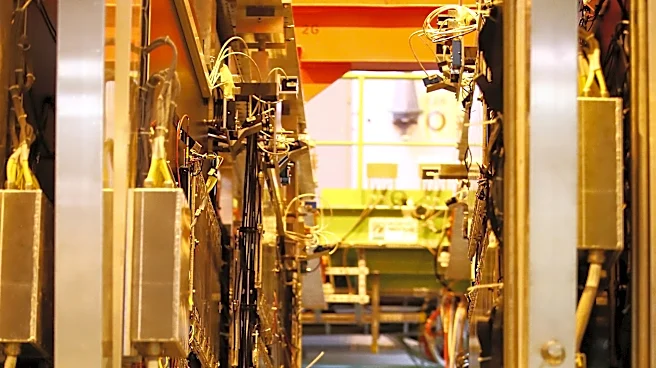
component of the dark sector theory is the introduction of an additional U(1)′ gauge group, which includes a dark photon that mediates interactions between the Standard Model and the dark sector. One specific example within this framework is the dark shower model, which postulates the existence of dark quarks. Experiments like Belle II are actively searching for evidence of these dark quarks, specifically looking for a single displaced vertex in electron-positron collisions, characterized by a dark rho decaying into two charged tracks. The analysis involves optimizing event selection criteria to identify signal events while suppressing background noise.
Why It's Important?
The dark sector theory represents a significant effort to extend the Standard Model of particle physics to explain the observed phenomena of dark matter. If confirmed, the existence of a dark sector with new particles and a dark photon would fundamentally alter our understanding of the universe's composition and the forces that govern it. This research could lead to the discovery of new fundamental particles and interactions, opening up entirely new avenues in physics. The Belle II experiment's search for dark quarks is a crucial step in testing these theoretical predictions. A successful detection would provide direct evidence for dark matter's particle nature, moving beyond its gravitational effects and potentially leading to a unified theory that incorporates both visible and dark matter.
What's Next?
The Belle II experiment will continue its search for an excess in the invariant mass distribution of the dark rho candidate, using data collected from electron-positron collisions. The ongoing analysis aims to refine event selection criteria and improve background suppression to enhance the sensitivity of the search. Future experiments at other particle accelerators may also be designed to probe the dark sector, potentially exploring different interaction channels or higher energy regimes. The theoretical framework of the dark sector theory will continue to evolve, incorporating new experimental constraints and refining predictions for the properties of dark matter particles and their interactions. The ultimate goal is to either detect direct evidence of dark matter particles or further constrain their properties, guiding future research.
Beyond the Headlines
The search for dark matter and the exploration of theories like the dark sector have profound implications for our understanding of the universe's fundamental laws. The existence of a 'dark' counterpart to the visible universe suggests that our current understanding of reality is incomplete. This pursuit challenges scientists to think beyond established paradigms and develop innovative experimental techniques. The potential discovery of new particles and forces could lead to unforeseen technological advancements and a deeper philosophical understanding of the cosmos. It also highlights the collaborative nature of international scientific research, with experiments like Belle II involving global participation to address some of the most fundamental questions in physics.