







What's Happening?
The U.S. Navy has placed its largest single order to date for HII's Lionfish underwater drones, committing $123.4 million for additional vehicles. This order, made on September 24, just six days before the federal fiscal year closed, is part of a broader
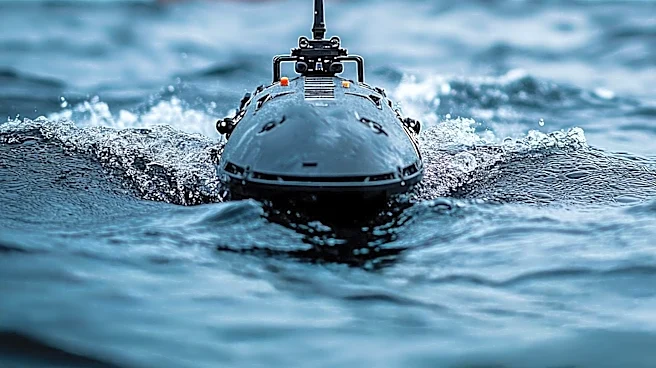
contract that could see the Navy acquire up to 200 of these autonomous submarines over five years, with a maximum value exceeding $347 million. The Lionfish, also known as HII's REMUS 300, is a torpedo-shaped autonomous submarine designed to be portable, with two people capable of carrying and launching it by hand. It can dive to 1,000 feet and operate for up to 30 hours on missions such as mine countermeasures, intelligence gathering, anti-submarine warfare, and electronic warfare. Deliveries under this new order are expected to run through December 2027. HII recently expanded its manufacturing facility in Pocasset, Massachusetts, by 25% just two days before the order was placed.
Why It's Important?
This significant order for Lionfish drone submarines marks a pivotal moment for the U.S. Navy's unmanned systems capabilities and has substantial implications for national defense and naval strategy. The ability to deploy small, highly autonomous underwater vehicles for mine hunting and other critical missions reduces the risk to human personnel and crewed vessels. This investment reflects a strategic shift towards leveraging advanced robotics and AI in naval operations, enhancing the Navy's capacity for reconnaissance, surveillance, and offensive actions in contested maritime environments. For the defense industry, this contract solidifies HII's position as a key provider of unmanned underwater vehicles and signals a growing market for such technologies. The modular design of the Lionfish allows for adaptable sensor payloads, making it a versatile asset for various operational needs. This procurement also highlights the Pentagon's accelerated acquisition processes for promising technologies, moving from prototyping to full-scale production.
What's Next?
Deliveries of the Lionfish drones under this new order are scheduled to continue through December 2027. The U.S. Navy is expected to integrate these new vehicles into its fleet, expanding its capabilities in mine countermeasures and other critical underwater operations. HII will continue to scale up production at its expanded facility in Pocasset, Massachusetts, to meet the demand. The Navy still holds options within the existing contract to acquire additional Lionfish vehicles, potentially reaching the target of 200 units. This ongoing procurement will likely drive further innovation in unmanned underwater vehicle technology, with continuous improvements in endurance, sensor capabilities, and autonomy. Other defense contractors may also intensify their efforts to develop competing or complementary systems, fostering a dynamic and competitive market for naval robotics. The successful deployment and operational performance of these drones will inform future naval acquisition strategies and doctrine.
Beyond the Headlines
The increasing reliance on autonomous underwater vehicles like the Lionfish raises broader questions about the future of naval warfare and international maritime security. The proliferation of such technologies could lead to new challenges in arms control and the definition of maritime boundaries. Ethical considerations surrounding autonomous weapons systems, particularly their decision-making capabilities in combat scenarios, will become more prominent. Furthermore, the development of advanced drone submarines could spark an arms race among global powers, potentially destabilizing existing naval balances. The cybersecurity of these unmanned systems is also a critical concern, as they could be vulnerable to hacking or electronic warfare attacks. The long-term implications extend to the transformation of naval personnel roles, requiring new training and skill sets to operate and maintain these sophisticated robotic platforms. This shift represents a fundamental change in how naval power is projected and maintained in the 21st century.