




What's Happening?
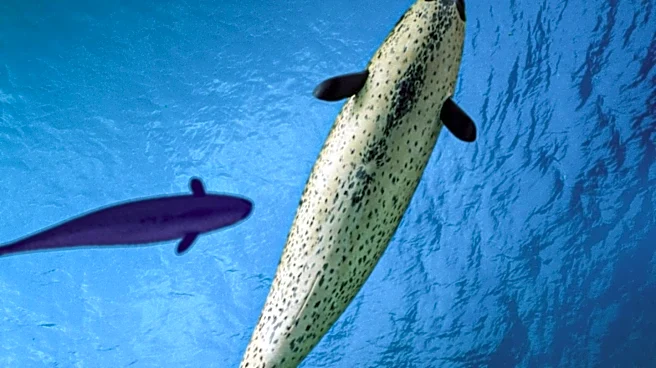
An international study published in 'Nature Communications' has uncovered a unique double helix internal structure within the narwhal's tusk. Researchers found that the tusk, known for being the only straight tusk in nature with a consistent leftward
macroscopic twist, possesses an outer layer that spirals left and an inner layer that spirals right. This discovery, made possible through advanced imaging techniques like X-rays and 3D tomography, explains how the tusk maintains its straight form while resisting significant torsion and flexion. The study analyzed the arrangement of mineralized collagen fibrils, which are the structural building blocks of the tissue, revealing systematic deviations that create this helical organization. This complex internal architecture provides enhanced mechanical stability compared to a simple or straight structure, offering insights into the tusk's exceptional durability.
Why It's Important?
This scientific breakthrough holds significant implications for both biology and engineering. From a biological perspective, it resolves a long-standing anatomical enigma regarding the narwhal's tusk, a unique biological structure. The understanding of how such a complex and robust structure is formed and maintained can shed light on evolutionary adaptations and the biomechanics of other biological materials. For engineering, the findings offer inspiration for the development of new bio-inspired materials. The tusk's anisotropic mechanical properties, where its response to force varies by direction, and its ability to deflect cracks due to its helical organization, present a blueprint for creating materials with superior strength, flexibility, and resistance to deformation. This could lead to advancements in fields requiring durable and lightweight materials, potentially impacting industries from aerospace to construction.
What's Next?
Future research will likely focus on understanding the precise developmental processes that lead to the formation of this double helix architecture in narwhal tusks. While the study has revealed the structure and its mechanical advantages, the exact biological mechanisms governing its growth remain unknown. Scientists may investigate the genetic and cellular factors involved in the mineralization and arrangement of collagen fibrils during the narwhal's development. Additionally, engineers may begin to experiment with replicating this double helix design in synthetic materials, exploring various manufacturing techniques to mimic the tusk's properties. This could involve advanced 3D printing or composite material fabrication, aiming to create novel materials with enhanced performance characteristics for diverse applications.
Beyond the Headlines
The discovery of the narwhal tusk's double helix structure transcends a mere anatomical finding; it highlights the profound ingenuity of natural design and its potential to inform human innovation. This research underscores the concept of biomimicry, where solutions to complex engineering challenges are found by observing and emulating nature's designs. The tusk's ability to combine rigidity with crack deflection, achieved through its intricate internal spirals, offers a powerful lesson in material science. It suggests that optimal strength and resilience often lie in complex, multi-layered, and anisotropic structures rather than simple, uniform ones. This could lead to a paradigm shift in how materials are designed, moving towards more biologically inspired, adaptable, and robust solutions, ultimately influencing sustainable design and advanced manufacturing practices.