



What's Happening?
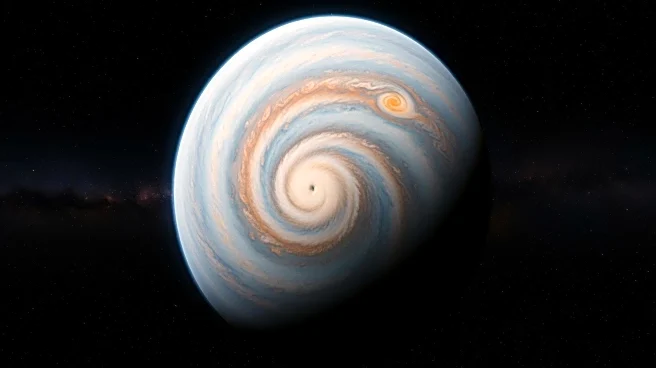
Recent measurements from NASA's Juno spacecraft have revealed that Jupiter is slightly smaller than previously thought. The new data indicates that Jupiter's equatorial diameter is about five miles shorter, and its polar diameter is about 15 miles shorter than earlier
estimates. These measurements were obtained through Juno's elongated orbit, which allows it to pass behind Jupiter and send radio signals back to Earth. The bending of these signals by Jupiter's atmosphere provides detailed maps of the planet's temperature and density, offering a clearer picture of its shape and size. This new information challenges previous data collected by NASA's Pioneer and Voyager missions, which had fewer data points.
Why It's Important?
The updated measurements of Jupiter's size are significant for several reasons. Firstly, they enhance the accuracy of models used to understand Jupiter's interior structure, which is crucial for studying gas giant planets. Accurate models help scientists better understand not only Jupiter but also other gas giants in our solar system and beyond. This knowledge is essential for comparative planetology, which seeks to understand the formation and evolution of planets. Additionally, the findings underscore the importance of continuous observation and data collection in refining scientific knowledge, as new technologies and missions can provide insights that challenge long-held assumptions.
What's Next?
The new measurements from Juno may lead to revisions in scientific textbooks and models of Jupiter's interior. Researchers will likely continue to analyze the data to refine their understanding of Jupiter's atmospheric and gravitational dynamics. The insights gained could influence future missions to Jupiter and other gas giants, as well as inform the search for exoplanets with similar characteristics. As Juno continues its mission, it may provide further data that could lead to additional discoveries about Jupiter and its moons.
Beyond the Headlines
The discovery of Jupiter's true size has broader implications for the field of astronomy. It highlights the dynamic nature of scientific inquiry, where new data can lead to significant shifts in understanding. This development also emphasizes the role of advanced technology in space exploration, as Juno's sophisticated instruments have enabled more precise measurements than were possible with earlier missions. The findings may also inspire renewed interest in the study of gas giants, both within our solar system and in distant star systems, as scientists seek to apply these insights to a broader context.