





What's Happening?
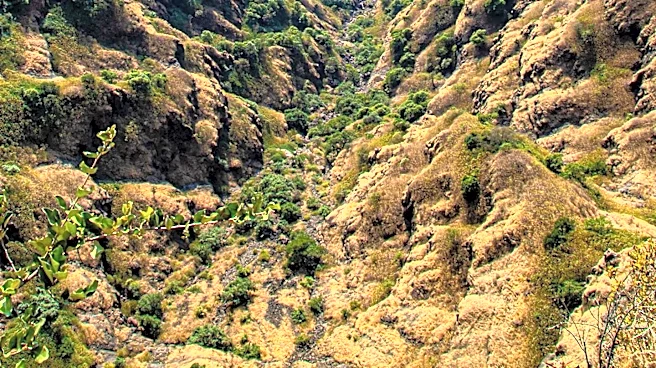
Research conducted in the Sindh Basin of Kashmir's Ganderbal district, within the northwestern Himalayas, has pinpointed the specific elevations where many of the region's springs receive their water. This study, published in the Journal of Earth System
Science in 2025, utilized field investigations, GIS mapping, and stable water isotope analysis to map potential spring recharge areas. The findings indicate an important elevation range of approximately 1,750-2,875 meters (5,741-9,432 feet) above sea level for spring recharge. Hydrogeologist Hilal Ahmad Sheikh, the lead author, emphasizes that understanding these recharge areas, rather than just the spring outlets, is crucial for effective conservation. The study also notes that factors like reduced snowfall at lower altitudes due to climate change and land use changes, including excavation, contribute to the decline of spring flows.
Why It's Important?
The decline of springs in the Kashmir Himalaya poses a significant threat to local communities, which rely on these water sources for households, livestock, and agriculture. This research provides critical scientific data to guide conservation efforts, shifting the focus from merely improving spring outlets to protecting the landscapes where water infiltrates the ground. Without addressing the health of these recharge areas, efforts to restore spring flow are likely to be ineffective. The findings highlight the interconnectedness of climate variability, land use, and water availability, underscoring the need for integrated watershed management. The agreement between the Jammu and Kashmir Integrated Watershed Management Programme and the University of Kashmir to prepare detailed project reports for springshed rejuvenation signifies a crucial step towards evidence-based conservation, potentially safeguarding water security for thousands of residents.
What's Next?
The immediate challenge is to translate these scientific findings into actionable conservation decisions. The agreement between the Jammu and Kashmir Integrated Watershed Management Programme and the University of Kashmir to develop detailed project reports for springshed rejuvenation, including hydrogeological assessments and recharge-zone mapping, is a key step. This suggests a move towards implementing interventions such as vegetation restoration, check dams, and rainwater-harvesting structures in the identified recharge areas. Geologists and hydrogeologists are expected to assess developmental projects before execution to prevent further disturbance to groundwater systems. Long-term monitoring of spring behavior and continued research will be essential to distinguish between seasonal fluctuations and sustained changes, ensuring that conservation strategies remain adaptive and effective.
Beyond the Headlines
This research underscores a broader environmental challenge faced by many mountainous regions globally, where climate change and human activities are impacting vital water resources. The emphasis on 'uphill' conservation reflects a paradigm shift in environmental management, recognizing that the health of a resource often depends on the integrity of its broader ecosystem. This approach has ethical implications, as it requires balancing developmental needs with ecological preservation and ensuring equitable access to water for all communities. Culturally, the drying springs represent a loss of traditional water sources and a disruption to long-standing community practices, highlighting the need for solutions that are both scientifically sound and culturally sensitive. The findings could serve as a model for other regions grappling with similar hydrological challenges.