


What's Happening?
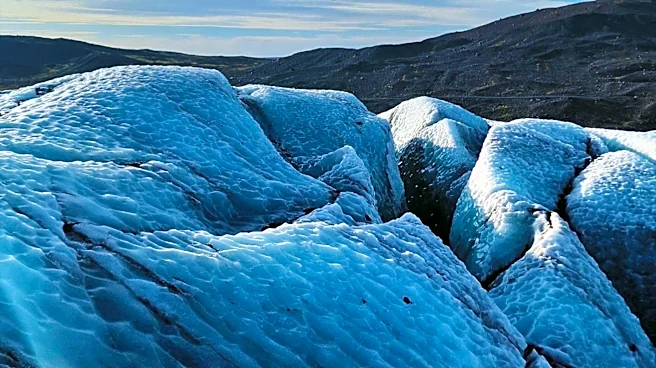
A new study published in the Proceedings of the National Academy of Sciences indicates that nearly 400 glaciers have disappeared across the Western United States as a result of climate warming. This represents over a quarter of the glaciers documented
in historical surveys. Andrew Fountain, a glaciologist at Portland State University who led the study, noted that this is a tangible indicator of climate change. The research compared glacier inventories from the 1950s-1980s with aerial and satellite imagery from around 2015, identifying over 1,300 glaciers across California, Colorado, Montana, Oregon, Washington, and Wyoming. Since the historical surveys, Western glaciers have lost approximately one-third of both their surface area and ice volume. Significant declines were observed in Montana's Beartooth Mountains and Absaroka Range (62%), Wyoming's Wind River Range (48%), and California's Sierra Nevada (64%).
Why It's Important?
The disappearance of these glaciers carries significant implications for the Western U.S. Glaciers serve as crucial natural reservoirs, releasing cold water into streams during the hottest and driest months, which is vital for sustaining high-elevation ecosystems and cold-water species. Unlike seasonal snowpack, glaciers provide a consistent water supply long after snowmelt. As glaciers shrink, their capacity to produce this water and mitigate droughts diminishes, making alpine watersheds more vulnerable to drought and warmer stream temperatures. This loss impacts water resources for communities, agriculture, and wildlife, potentially leading to increased water scarcity and ecological disruption in the affected regions. The study highlights a critical environmental shift with broad consequences for the region's natural systems and human populations.
What's Next?
Researchers warn that continued ice loss will exacerbate existing challenges related to water management and ecosystem health in the Western U.S. Future efforts will likely focus on monitoring the remaining glaciers and assessing the long-term impacts on water availability and biodiversity. Policymakers may face increased pressure to develop strategies for water conservation and climate change mitigation to address these environmental shifts. Communities reliant on glacial meltwater may need to explore alternative water sources or implement more stringent water management practices. Further studies will likely investigate the specific vulnerabilities of different alpine watersheds and the potential for adaptation strategies to cope with reduced glacial contributions.
Beyond the Headlines
The widespread disappearance of glaciers in the Western U.S. extends beyond immediate ecological and hydrological concerns, touching upon the aesthetic and cultural value of these natural landscapes. As glaciologist Andrew Fountain noted, there is a profound sadness in witnessing these beautiful landscape features vanish. This loss represents a visible manifestation of broader climate change impacts, serving as a stark reminder of the ongoing environmental transformation. It underscores the interconnectedness of global climate patterns with local ecosystems and highlights the urgency of addressing climate change on a larger scale. The study also points to the varying resilience of glaciers based on local terrain, suggesting that some microclimates may offer temporary refuges, but the overall trend remains one of significant decline.