






What's Happening?
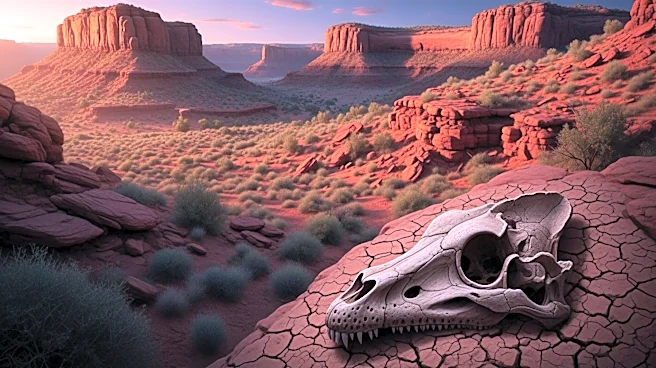
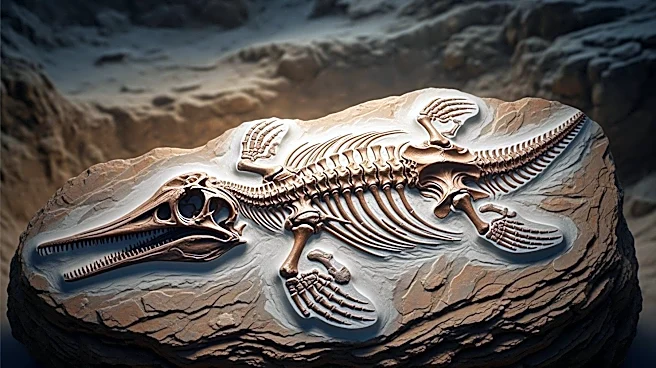
A team of paleontologists from the Natural History Museum of Los Angeles County has announced the discovery of a new species, Labrujasuchus expectatus, in New Mexico. This species, nicknamed the 'witch croc', is a bipedal, toothless crocodile relative
from the Triassic Period. The remains were found at Ghost Ranch, a site known for its rich fossil history. Labrujasuchus resembles ornithomimosaurs, a group of bipedal dinosaurs, despite being a crocodile-line archosaur. This discovery fills a gap in the evolutionary history of shuvosaurs, a group of beaked, bipedal archosaurs that lived in the Southern US during the Late Triassic. The species name 'expectatus' reflects the anticipated discovery of such a link. The research, published in the Journal of Vertebrate Paleontology, highlights the convergent evolution of reptiles during the Triassic, where similar body plans were experimented with by both crocodile relatives and dinosaurs.
Why It's Important?
The discovery of Labrujasuchus expectatus is significant as it provides insights into the evolutionary history of reptiles during the Triassic Period. This period was crucial for the development of many successful strategies seen in modern animals and non-avian dinosaurs. The 'witch croc' exemplifies convergent evolution, where unrelated species develop similar traits. Understanding these evolutionary paths can help scientists better comprehend the diversity and adaptability of ancient reptiles. Additionally, the find at Ghost Ranch, a site with a storied history of paleontological discoveries, underscores the importance of continued exploration and study of fossil-rich areas. Such discoveries can inform current scientific understanding and potentially lead to new insights into the evolutionary processes that shaped the biodiversity of the past.
What's Next?
The discovery of Labrujasuchus expectatus opens new avenues for research into the evolutionary history of shuvosaurs and other Triassic reptiles. Paleontologists may continue excavations at Ghost Ranch and similar sites to uncover more fossils that could provide further insights into the diversity and adaptations of ancient reptiles. The study of these fossils can also contribute to broader discussions on evolutionary biology and the factors that drive convergent evolution. As more fossils are discovered and analyzed, scientists can refine their understanding of the evolutionary relationships between different reptile groups and the environmental conditions that influenced their development.