




What's Happening?
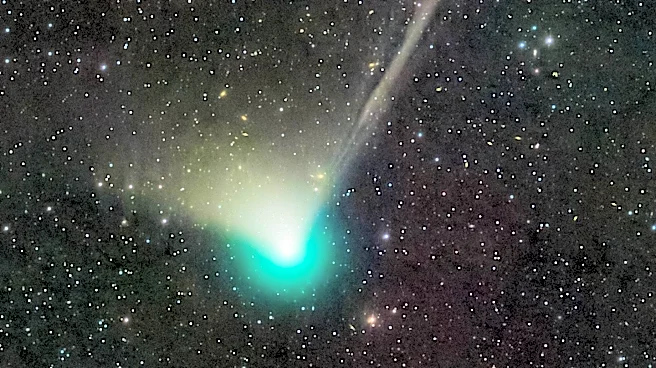
Comet Tempel 2, also known as Comet 10P/Tempel, is currently visible in the constellation Scutum and is expected to remain observable throughout the summer. The comet, which is approximately 12th magnitude, is brightening and can be seen with a large
telescope. It is positioned about 35 degrees above the horizon around 5 A.M. local daylight time. The comet is located just under 2 degrees southwest of the 4th-magnitude star Alpha Scuti. As it brightens, it will become more comparable in visibility to the nearby globular cluster NGC 6712, which is currently around 8th magnitude. Observers are encouraged to compare the comet's appearance to the cluster over time. Additionally, Comet C/2025 R3 (PanSTARRS) is also visible in the early morning sky, having reached mid-5th magnitude, making it potentially visible to the naked eye under optimal conditions.
Why It's Important?
The visibility of Comet Tempel 2 provides a unique opportunity for astronomers and skywatchers to observe a celestial event that is not frequently visible. The comet's presence in the sky offers a chance for both amateur and professional astronomers to study its characteristics and behavior as it brightens over the summer. This event also highlights the dynamic nature of our solar system and the ongoing opportunities for discovery and observation. The appearance of Comet C/2025 R3 (PanSTARRS) adds to the excitement, as it is a relatively rare occurrence for two comets to be visible in the sky simultaneously. These events can inspire interest in astronomy and provide educational opportunities for those interested in learning more about comets and their trajectories.
What's Next?
As Comet Tempel 2 continues to brighten, astronomers will likely conduct further observations to study its composition and trajectory. The comet's visibility will improve as it rises higher in the sky, making it more accessible for observation. Skywatchers are encouraged to take advantage of clear skies and use telescopes or binoculars to view the comet. The presence of Comet C/2025 R3 (PanSTARRS) will also continue to be a point of interest, with its visibility expected to improve as it approaches perihelion. Observers should monitor updates from astronomical organizations for the best viewing times and conditions.