


What's Happening?
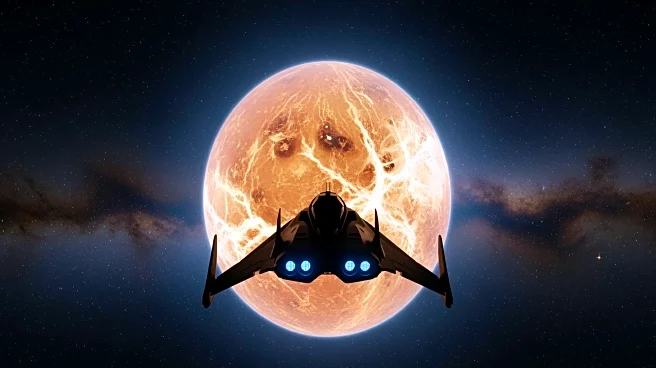
Russia has announced its ambitious Venera-D mission, set to launch in 2036, aiming to explore Venus with a lander, balloon, and orbiter. This mission marks a significant return to Venus, where the Soviet Union first landed a spacecraft over 50 years ago.
The Venera-D mission is designed to study Venus's harsh environment and potential for life, building on Russia's historical achievements in space exploration. The mission will include a balloon to explore Venus's thick atmosphere, an orbiter to study the surface, and a lander capable of withstanding extreme conditions. This initiative is part of Russia's effort to reassert its position in the global space race, especially after diminished partnerships with NASA and the European Space Agency.
Why It's Important?
The Venera-D mission is crucial for Russia as it seeks to regain its status as a leader in space exploration. By targeting Venus, Russia aims to build on its legacy of successful planetary missions and compete with other nations like the U.S., Europe, and India, which also have Venus missions planned. The mission's success could enhance Russia's technological capabilities and scientific understanding of Venus, potentially leading to discoveries about the planet's atmosphere and the possibility of microbial life. This could have broader implications for international space cooperation and competition, influencing future space policies and collaborations.
What's Next?
As Russia prepares for the Venera-D mission, it will likely focus on developing the necessary technology and infrastructure to support the mission's complex objectives. The mission's success could prompt further exploration of Venus and potentially lead to new international partnerships or rivalries in space exploration. Other countries, including the U.S. and India, are also planning missions to Venus, which could lead to increased competition and collaboration in the field of planetary science. The findings from these missions could significantly impact our understanding of Venus and its potential for life.
Beyond the Headlines
The Venera-D mission highlights the ongoing geopolitical dynamics in space exploration, with Russia seeking to assert its influence amid global competition. The mission also raises questions about the sustainability and ethics of space exploration, particularly in terms of resource allocation and international cooperation. As more countries and private entities enter the space race, there may be increased pressure to establish international regulations and agreements to ensure peaceful and sustainable exploration of other planets.