





What's Happening?
Only eight out of 160 utility companies operating in fire-prone regions of Texas have complied with a state law requiring them to file wildfire mitigation plans. This revelation came during a House State Affairs committee hearing, led by Representative
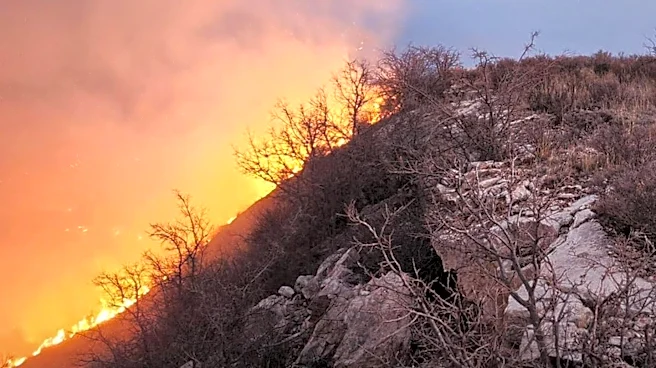
Ken King, who championed the legislation last year following the devastating Smokehouse Creek wildfires in 2024. The law, House Bill 145, mandates that utility companies submit plans detailing emergency protocols, operating procedures during high-risk weather, vegetation management, equipment inspection, and identified wildfire risk areas to the Public Utility Commission (PUC). The Smokehouse Creek fires, the largest in Texas history, were linked to a decayed power pole owned by Xcel Energy. While Xcel Energy, through its subsidiary Southwestern Public Service Company, has submitted its plan and implemented measures like 97 wildfire detection cameras and Public Safety Power Shutoffs, the overall compliance rate across the state remains low. Connie Corona, director at the PUC, noted that while 135 companies are preparing plans and four have provided filing dates, 13 have not communicated their intentions.
Why It's Important?
The widespread non-compliance with Texas's wildfire mitigation law poses a significant risk to public safety and property, especially given the state's active wildfire season. The 2024 Smokehouse Creek wildfires, which were largely attributed to electrical ignitions, underscore the critical need for robust preventative measures from utility companies. The failure of the majority of utilities to submit their plans leaves communities vulnerable to future electrical-ignition fires, potentially leading to further loss of life, property, and environmental damage. This situation also highlights a potential regulatory enforcement challenge, as lawmakers express disappointment with the industry's slow response. The economic impact of wildfires, including property damage, agricultural losses, and the costs of emergency response, can be substantial. For companies like Xcel Energy that have been directly implicated in past fires, proactive measures and compliance are crucial for rebuilding public trust and mitigating future liabilities. The lack of comprehensive planning across the industry could also lead to increased insurance premiums and operational costs for utilities in the long run.
What's Next?
Representative Ken King has issued a stern warning to non-compliant utility companies, emphasizing that the January deadline for filing wildfire mitigation plans is firm. He indicated that lawmakers will be closely monitoring compliance and will assess the situation in January. The PUC has provided a model wildfire mitigation plan to assist smaller utility companies, suggesting a continued effort to facilitate compliance. Utility representatives, such as Mark Bell from the Association of Electric Companies of Texas, have assured lawmakers that their member companies are on track to file their plans by the end of the year. Additionally, pole and maintenance plans, which will detail a complete inventory of utility assets in Texas, are also due in January. The ongoing active wildfire season and the continued occurrence of electrical-ignition fires, even if fewer than in 2024, will maintain pressure on utilities and regulators to ensure these plans are not only filed but effectively implemented to prevent future disasters.
Beyond the Headlines
The issue of utility compliance with wildfire mitigation laws extends beyond immediate safety concerns to touch upon broader themes of corporate responsibility, regulatory effectiveness, and the challenges of infrastructure management in an era of increasing climate-related risks. The slow adoption of these critical plans by a majority of utilities suggests potential systemic issues, such as resource constraints, bureaucratic inertia, or a lack of perceived urgency within some companies. The fact that Xcel Energy, a company heavily criticized after the 2024 fires, has become proactive highlights how past disasters can drive change, but also raises questions about why such measures aren't universally adopted proactively. This situation also brings to light the complex interplay between state legislation, regulatory oversight, and industry self-governance in ensuring public safety. The long-term implications include the potential for stricter regulations, increased legal liabilities for non-compliant utilities, and a shift in public perception regarding the energy sector's commitment to environmental and community safety.