



What's Happening?
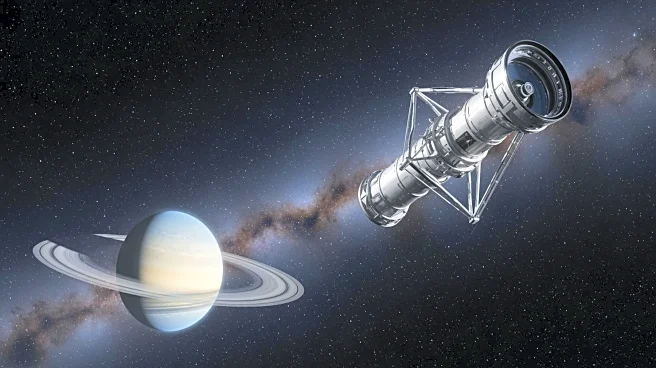
Astronomers have successfully measured the mass of a rogue planet, comparable in size to Saturn, using a method called gravitational microlensing. This technique, which relies on the warping of spacetime by massive objects, was employed by Subo Dong of Peking
University and his team. The discovery was made possible through an exceptional alignment between the rogue planet, a distant background star, and two observation points: Earth and the Gaia space telescope. The event was detected simultaneously from Earth and the now-retired Gaia observatory, allowing scientists to measure the planet's gravitational effect from two different angles. This breakthrough marks the first time the mass of such a free-floating planet has been directly measured, providing a significant advancement in the study of these elusive celestial bodies.
Why It's Important?
The ability to measure the mass of a rogue planet represents a major leap in exoplanetary science. Rogue planets, which do not orbit a star, are difficult to detect and study due to their lack of emitted light and observable orbits. This discovery opens new avenues for understanding these mysterious objects, which are believed to have formed in star systems before being ejected. The successful application of gravitational microlensing in this context suggests that similar techniques could be used to study other rogue planets, potentially leading to new insights into their formation and characteristics. This advancement could significantly enhance our understanding of planetary systems and the dynamics of celestial bodies in the universe.