




What's Happening?
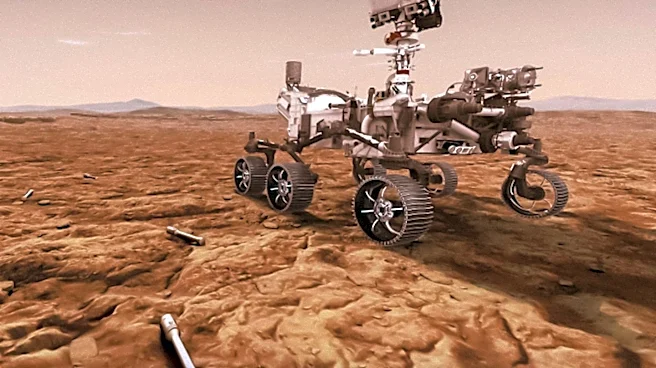
NASA's Perseverance Mars rover has achieved a new milestone, traveling 28.10 miles across the Martian surface, surpassing any previous vehicle in history. This feat was accomplished in less than six years, significantly faster than the previous record
holder, NASA's Opportunity rover, which took nearly 15 years to cover a slightly shorter distance of 28.06 miles. Perseverance, which began its operations on Mars on February 18, 2021, landed in the Jezero Crater, an ancient river delta believed to have once supported microbial life. The rover has been conducting extensive sediment drilling surveys and chemically analyzing samples using its onboard laboratory equipment, with results transmitted back to NASA specialists. A key factor in its rapid progress is the AutoNav self-piloting system, which has guided 90 percent of its total excursion by constructing 3D maps and charting routes to avoid hazards. The mission has received an extension, with operations now approved through the end of 2028, indicating expectations for the rover to continue setting new records.
Why It's Important?
This achievement by the Perseverance rover is significant for several reasons, primarily advancing the U.S. space exploration program and its understanding of Mars. The rapid and largely autonomous traversal of the Martian surface demonstrates the effectiveness of advanced robotic technology, particularly the AutoNav system, which could be crucial for future long-duration missions to distant celestial bodies. By exceeding its initial mission goal of 12.4 miles, Perseverance is providing an unprecedented amount of data from diverse Martian landscapes, including the potentially oldest landscape ever investigated in the solar system near Jezero Crater's western rim. This data is vital for scientists studying the planet's geological history, potential for past life, and the evolution of planetary environments. The extended mission through 2028 ensures continued scientific returns, contributing to a deeper understanding of Mars and informing future human missions, potentially reducing risks and increasing efficiency for astronauts. The success also reinforces NASA's leadership in robotic planetary exploration and inspires further innovation in autonomous systems.
What's Next?
With its mission extended through the end of 2028, Perseverance is expected to continue its journey across Mars, further exploring the region near Jezero Crater. The rover is currently heading towards an area named Idubi, through an expanse nicknamed 'Lac de Charmes.' Mission engineers anticipate that the rover will continue to add to its distance record for many years, given that all mobility systems are fully operational and extended-ground-life test results have been favorable. The ongoing operations will involve more sediment drilling surveys and chemical analyses, providing additional insights into Mars's geological and potential biological history. The data collected will be continuously transmitted back to NASA, contributing to a growing body of knowledge about the Red Planet. Future plans will likely involve leveraging the success of the AutoNav system for subsequent missions, potentially enabling even more ambitious and efficient robotic explorations.
Beyond the Headlines
The Perseverance rover's record-breaking journey highlights a profound shift in space exploration capabilities, moving towards greater autonomy and efficiency. The AutoNav system, which allows the rover to navigate 90 percent of its path independently, represents a significant leap in artificial intelligence and robotics for extraterrestrial environments. This technological advancement has implications beyond Mars exploration, potentially influencing the design of future robotic missions to other planets and moons, where direct human control is impractical due to communication delays. Furthermore, the continuous collection of geological and chemical data from Mars contributes to a broader scientific understanding of planetary formation and the conditions necessary for life, which could inform astrobiological research and the search for life beyond Earth. The longevity and success of the mission also underscore the importance of sustained investment in scientific research and development, fostering innovation that can have unforeseen benefits for technology and human understanding.